

TL;DR:
- Water clarity is scientifically measured by the Secchi disk, with higher depths indicating more transparent water. Destinations like Lake Tahoe, Sardinia, and the Maldives are renowned for their exceptional water clarity due to geology, ecology, and conservation efforts. Travelers can find genuinely clear waters by checking official quality ratings, visiting sheltered bays, and reviewing recent visitor photos for real-time conditions.
Few phrases in travel writing carry as much allure as "crystal-clear waters," yet most people have never paused to ask what the expression truly means. The Oxford dictionary defines "crystal clear" as water that is completely transparent and bright, a standard that goes well beyond a pleasing visual impression. Understanding what are crystal-clear waters, from their scientific measurement to the ecological forces that create them, transforms the way you choose destinations and appreciate the sea. This guide unpacks the science, the geography, and the travel wisdom behind one of nature's most captivating phenomena.
What are crystal-clear waters, scientifically speaking?
Water clarity is not simply a matter of opinion. Aquatic scientists have spent decades developing precise ways to measure transparency, and the results reveal why some coastlines and lakes appear almost otherworldly while others remain murky regardless of the season.
The Secchi disk method
The standard tool for measuring water transparency worldwide is the Secchi disk, a simple black-and-white circle lowered into the water on a measured line. The depth at which it disappears from view is called the Secchi depth, and it serves as the primary scientific benchmark for water clarity. A higher Secchi depth reading indicates greater transparency. In the clearest natural waters on Earth, that reading can exceed 30 metres.
The method is elegantly simple, but it is not without limitations. Measurements vary depending on sunlight angle, the observer's eyesight, and whether conditions introduce glare on the surface. Scientists account for this by standardising the time of day and repeating readings. The underlying principle, however, remains unchanged since the Italian astronomer Pietro Angelo Secchi first proposed it in 1865.
What reduces clarity in natural water?
The clearest water is, essentially, water with very little in it. The key characteristics of clear water include:
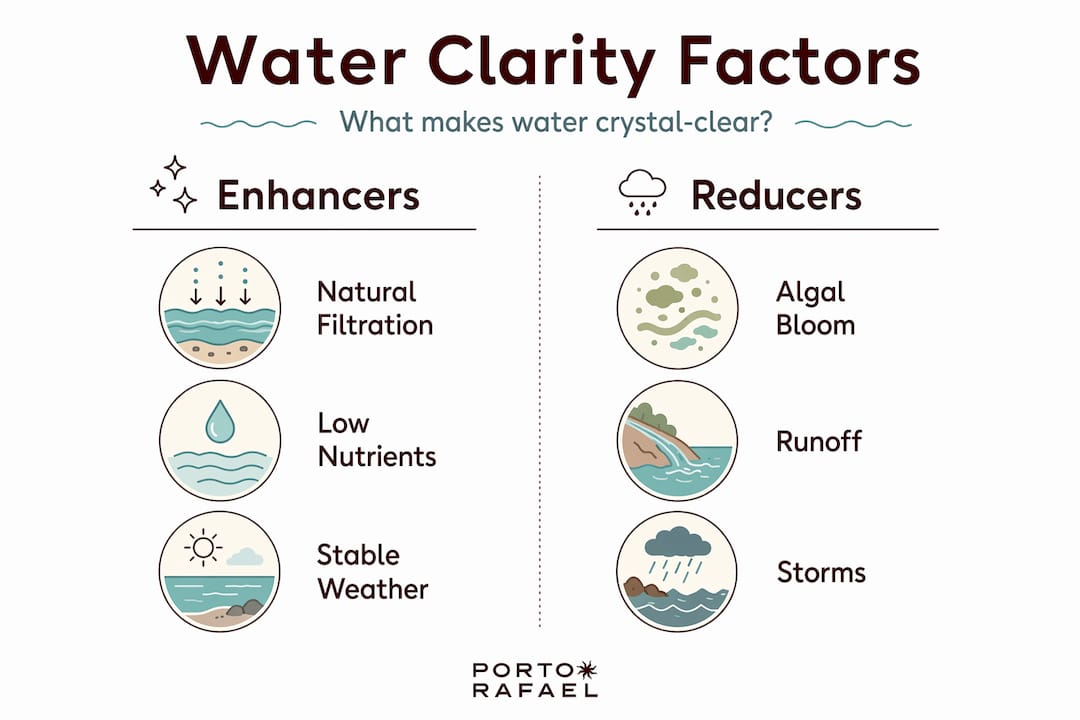
- Low suspended particles. Phytoplankton and sediment scatter and absorb light, reducing how far it penetrates.
- Minimal dissolved organic matter. Tannins from decaying leaves, for example, give many rivers a tea-coloured tint.
- Limited nutrient pollution. High nitrogen and phosphorus levels feed algal growth, which clouds water rapidly.
- Stable water column. Strong wave action or river inflow stirs sediment from the seabed, temporarily reducing clarity even in otherwise pristine locations.
Pro Tip: When reading travel reviews, look for mentions of being able to see the seabed clearly at depth, not just the colour of the water from above. Turquoise water can look stunning in photographs yet still have relatively low transparency closer to shore.
Understanding the definition of crystal-clear waters at this level helps you read between the lines of glossy holiday brochures and make genuinely informed choices about where you travel.
Natural factors that shape water clarity
The conditions required to produce truly transparent water are rarely accidental. They arise from a specific combination of geography, climate, and ecology working together over long periods of time.
Geology and natural filtration
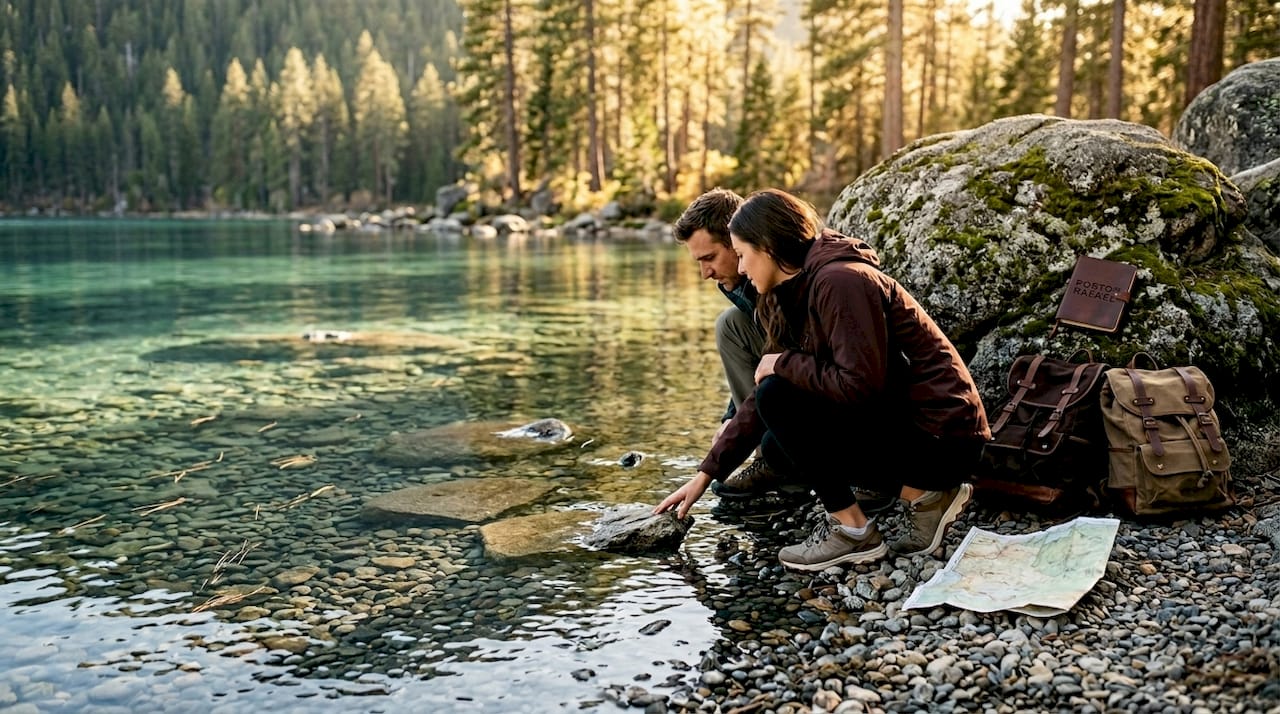
One of the most striking examples of geology influencing water clarity is Lake Tahoe on the California-Nevada border. The lake's water passes through granite bedrock before feeding the basin via snowmelt, a natural filtration process that strips out sediment and leaves the water with visibility exceeding 100 feet in ideal conditions. The lake sits at high altitude, which also limits nutrient-rich runoff from agriculture and development.
The Mediterranean Sea benefits from comparable dynamics on a grander scale. Its relative isolation, low tidal range, and warm temperatures support consistent water clarity in sheltered bays and coves, particularly along the coasts of Sardinia, Croatia, and the Greek islands. The limited freshwater inflow compared to the Atlantic Ocean means suspended particles from rivers have less influence on coastal transparency.
Seasonal and weather variability
Water clarity is never static. The same beach that reveals every pebble on the seabed in June can be visibly murky in November after sustained autumn storms. Consider the contrasts below:
| Factor | Effect on clarity | Typical timing |
|---|---|---|
| Spring algal bloom | Significant reduction | March to May |
| Summer calm seas | Improved transparency | June to September |
| Autumn rainfall and runoff | Temporary reduction | October to November |
| Winter storms | Sediment disturbance | December to February |
Coastal development adds another layer of risk. Construction, agriculture, and urban drainage all introduce nutrients and fine particles into coastal waters. Even naturally clear locations are vulnerable if the surrounding land is not managed with care. The benefits of clear water, including thriving seagrass meadows, healthy coral, and visible marine life, depend entirely on the absence of these pressures.
How travellers can find genuinely clear waters
Science gives us the framework, but practical travel requires a slightly different kind of knowledge. The good news is that several publicly available tools and standards make it far easier to identify destinations where water clarity is both genuine and consistently maintained.
- Check official water quality ratings. In the United Kingdom, bathing waters are rated on a four-point scale: Excellent, Good, Sufficient, and Poor. An "Excellent" rating does not guarantee visual transparency, but it confirms that suspended bacteria and pollutants are well below harmful thresholds, conditions that often correlate with clear water.
- Look for Blue Flag certification. Blue Flag beaches undergo rigorous water quality testing throughout the season, along with environmental management standards that protect the coastal ecosystem. An award-winning beach is a reliable starting point for finding clear water.
- Choose sheltered bays over exposed headlands. Open coastlines are beautiful, but wave action disturbs sediment continuously. Sheltered coves and lagoons maintain clarity far more reliably, particularly during the summer months.
- Travel in the right window. Late summer, from late July through early September, typically offers the best conditions across Mediterranean destinations. Algal blooms have usually subsided, the sea has settled, and tourist infrastructure is fully operational without the extreme crowds of peak July.
- Read recent visitor accounts rather than stock photography. Satellite imagery and drone photography often capture water on exceptionally calm, cloud-free days. A quick search for recent visitor photographs or travel forum discussions from the current season provides a far more accurate picture.
Pro Tip: Many coastal regions in Italy and Spain publish weekly water quality bulletins during summer. A brief search on the regional environmental agency's website, often available in English, gives you real-time clarity data before you book.
Knowing how to find clear waters is as much about timing and research as it is about choosing the right country. The clearest waters in the world can look disappointing after a week of rainfall; even moderately clear destinations can feel extraordinary when conditions align perfectly.
Destinations celebrated for exceptional water clarity
A handful of places have earned a global reputation for waters that seem almost unreal in their transparency. What they share is not luck but a particular convergence of geography, conservation, and climate.
- Lake Tahoe, USA. As noted, Lake Tahoe's clarity is a product of granite filtration, high altitude, and careful environmental protection spanning more than five decades. At its clearest, visibility exceeds 30 metres. It remains one of the most studied bodies of water on Earth precisely because its clarity serves as a barometer of ecological health.
- The Maldives. Warm, shallow atolls with minimal freshwater input and extensive coral reef systems create conditions where Secchi depth readings regularly exceed 25 metres. The coral itself plays a role, filtering particulates and stabilising sediment.
- Sardinia's Gallura coast, Italy. The waters off Porto Rafael and the wider Gallura region are renowned across the Mediterranean for a quality that feels almost impossible: the kind of transparency where you can count the stones on the seabed from a boat. The granite geology of northern Sardinia mirrors the Lake Tahoe effect on a coastal scale, with clean runoff and limited agriculture preserving clarity season after season. These crystal-clear Sardinian waters have become central to the region's identity as a luxury destination.
- Southern Corsica. The sheltered bays between Bonifacio and Porto-Vecchio offer spectacular transparency, drawing visitors who prize the rare combination of dramatic landscape and immaculate water. The finest beaches of Southern Corsica share many of the same geological conditions as northern Sardinia, lying just kilometres apart across the Straits of Bonifacio.
- The Turks and Caicos, Caribbean. Shallow banks of white sand, minimal river inflow, and a protected marine park system combine to produce water clarity that regularly features in lists of the world's most photogenic coastlines.
What these destinations share is that water clarity reflects ecological health rather than simply aesthetic appeal. Where the water is clear, the ecosystem beneath it is usually thriving.
Why the science of clarity changed how I see travel
I'll be honest. I spent years admiring clear water without ever thinking seriously about why it was clear, and I believe most travellers still do. That changed the first time I tried to explain to someone why two bays on the same island could look so different from one another, one a luminous jade green, the other a flat grey despite identical weather conditions.
What I've learned from looking into the science is that Secchi depth standardisation has real limits, and that even experts acknowledge a measurement gap between what science can capture and what the human eye perceives as exceptional. That gap matters for travellers, because it means the words "crystal clear" in a travel article carry almost no reliable information unless they are backed by quality ratings or consistent visitor testimony over time.
My view is that informed appreciation of clear water is also a form of conservation advocacy. When you understand that phytoplankton blooms and runoff can erase a lifetime of clarity within a single season, you begin to see the coastal ecosystem very differently. You choose destinations that protect what they have. You notice when something has changed. You ask questions rather than simply clicking "book."
Clear water is not a backdrop. It is evidence of something working well, and it deserves that kind of attention.
— Studio
Experience crystal-clear waters at Porto Rafael
There are destinations that photograph beautifully, and then there are places that genuinely change the way you experience water. Porto Rafael, a rare gem tucked along the Gallura coast of northern Sardinia, belongs firmly in the second category.

The waters surrounding this captivating boutique village carry the kind of transparency that makes the sea floor visible at depths that feel impossible elsewhere. Guests staying at the Prestige rooms of Hotel La Piazza wake to views that frame this luminous coast in all its timeless beauty. After a morning on the water, the gourmet kitchen at Solaz Restaurant offers local Sardinian flavours that feel every bit as refined as the scenery. For those planning a stay, a look at Gallura's most celebrated beaches reveals just how extraordinary this coastline truly is.
FAQ
What is the definition of crystal-clear waters?
Crystal-clear water is completely transparent and bright, allowing unobstructed vision through it to significant depth. Scientifically, it refers to water with very low levels of suspended particles, dissolved organic matter, and biological material.
How is water clarity measured scientifically?
Water clarity is measured using a Secchi disk, a black-and-white disc lowered into the water until it disappears from view. The depth at which visibility is lost, called the Secchi depth, is the standard global measure of water transparency.
Why are some coastal waters clearer than others?
Clarity depends on geology, nutrient levels, and seasonal conditions. Locations with granite bedrock, limited agricultural runoff, and sheltered bays, such as the coasts of Sardinia and the Maldives, naturally maintain higher transparency than areas affected by river sediment or algal blooms.
What are the benefits of clear water for travellers and ecosystems?
Clear water supports thriving marine habitats, including seagrass beds and coral reefs, which in turn provide richer snorkelling and diving experiences. For travellers, it also signals that water quality standards are consistently maintained, making it safer and more enjoyable to swim.
How can I identify genuinely clear waters before travelling?
Look for beaches with Blue Flag certification or "Excellent" ratings under official bathing water classification schemes. Combining these ratings with recent visitor photographs taken in the current season gives the most reliable picture of what to expect.