
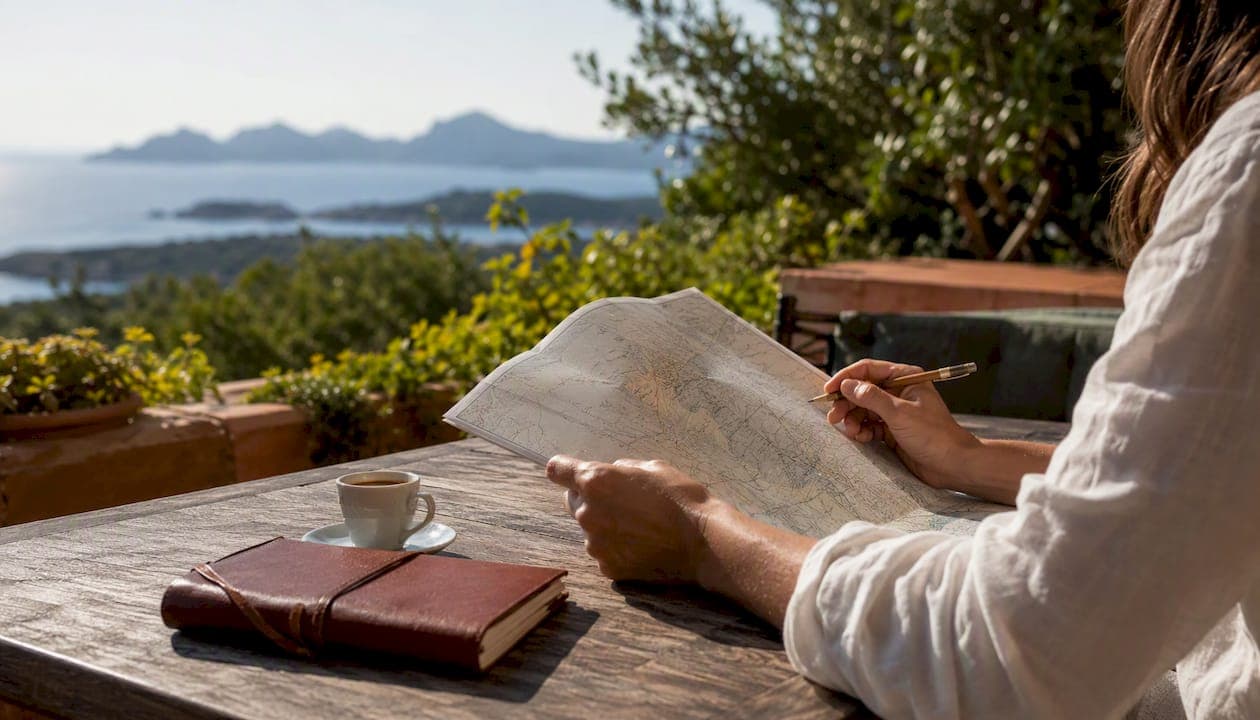
You can design a genuinely bespoke luxury excursion by following a five-step process that turns preferences into access, rhythm, and service. The workflow runs: discovery, concept, detailed itinerary, final polish, and in-journey orchestration. Each stage produces a concrete deliverable, and together they create the kind of personalised luxury travel that feels effortless to the guest precisely because it was painstaking to design. Private excursions in Sardinia have grown by roughly 63%, a figure that reflects a broader Italian shift: affluent travellers no longer want a premium product, they want a premium experience shaped entirely around them.
Before you commission a single supplier, four elements must be in place:
- A detailed client profile capturing pace tolerance, dietary needs, cultural interests, and non-negotiables
- Clear pacing rules (maximum daily moves, preferred wake and rest times, recovery afternoons)
- An exclusive access plan listing which experiences require permits, introductions, or advance relationships
- A vetted local partner list with written references and confirmed insurance
Pro Tip: Run a 20-minute discovery call before any written brief. The single most revealing question is: "Tell me about a trip that disappointed you." The answer surfaces hidden expectations faster than any questionnaire.
What does bespoke luxury travel actually mean?
The industry term for this category is tailor-made or bespoke travel, and it is worth distinguishing it from standard luxury clearly. Standard luxury is product-led: a five-star hotel, a business-class seat, a Michelin-starred table. Bespoke travel is client-led, built around pace and priorities, and it requires curation and repeated quality control rather than assembling available inventory.
The practical difference shows up in three places. Access: a standard luxury guest books what is publicly available; a bespoke guest accesses what is not listed. Pacing: a standard itinerary fills every hour; a bespoke one protects recovery time as deliberately as it schedules activity. Rhythm: a standard trip moves between destinations; a bespoke one sequences them so each location deepens the feeling of the one before.
Italy amplifies all three differences. Private access to a Florentine palazzo or a Sardinian vineyard requires relationships, not just money. Seasonal restaurant and vineyard lead times can stretch to six months for peak windows. And the country's permit culture, from Soprintendenza approvals for archaeological sites to Comune licences for private events on public land, means that access planning must begin long before the itinerary is written.
The five pillars of truly customised luxury excursions
Every decision in a bespoke excursion maps back to one of five design pillars. Understanding them lets you evaluate any supplier's proposal against a consistent framework, and they apply equally whether you are designing a single day on the Sardinian coast or a ten-day exclusive Sardinia itinerary.
Discovery and client profiling. The brief is only as good as the questions behind it. Go beyond dietary requirements and ask about sensory preferences: does the client prefer silence or ambient sound, morning light or golden hour, intimate tables or panoramic terraces?
Pro Tip: Ask clients to send three images that represent how they want to feel on the trip, not where they want to go. The visual language reveals emotional design priorities that words rarely capture.
Access and partnerships. Private experiences require introductions that exist outside standard booking channels. A winemaker who opens her cellar after hours, a museum curator who walks guests through a closed gallery, a fishing family who shares their morning catch: these moments are only available through trusted local relationships.
Pacing and sequencing. The number of hotel moves directly affects how rested a guest feels. Two moves in seven days is comfortable for most; three or more requires deliberate recovery afternoons built into the schedule. Sequencing also matters: a high-stimulation city day followed immediately by a remote coastal experience feels jarring; a transitional afternoon on a private boat smooths the shift.
Accommodation choreography. Room category, orientation, and arrival timing are as important as the property itself. A sea-view suite that faces west rewards a guest who rises late; an east-facing room suits the early riser who wants dawn light over the water. Confirming these details with the property before arrival is non-negotiable.
Storytelling and exclusivity. The experiences that guests remember longest are those that carry a narrative: a private dinner in a Sardinian stazzo farmhouse where the host explains the history of the land, or a guided walk through a Roman ruin with an archaeologist who excavated it. Exclusivity without story is merely privacy; story transforms it into meaning.
How to commission a bespoke luxury excursion, step by step
A stepwise approach, profiling clients, choosing destinations, designing activities, and selecting premium accommodations, is the most reliable template for translating preferences into a finished itinerary.
-
Discovery. Conduct a structured 30-minute call or send a written questionnaire covering: travel party composition, pace tolerance (slow/moderate/active), cultural interests, cuisine preferences, transport comfort (boat, helicopter, road), budget range, and past trips that inspired or disappointed. Capture non-obvious preferences: preferred room temperature, whether the client reads on holiday, attitude to spontaneity.
-
Concept. Present two concept options, not one. A single concept forces a yes/no decision; two options reveal which direction the client leans and open a productive conversation. Each concept document should include: a mood statement (one paragraph on how the trip should feel), a destination sequence with rationale, three signature experiences, and a rough cost band.
-
Detailed itinerary. Once a concept is approved, build the full itinerary with routing, transfer timings, supplier contacts, confirmation numbers, contingency options for weather or permit delays, and a daily briefing note for the on-trip concierge. Every supplier should receive a written brief, not just a booking confirmation.
-
Final polish and pre-departure. Deliver a guest document pack: a day-by-day itinerary in plain language, emergency contacts, special access confirmations, dress codes, and a one-page "what to expect" note for any experience that might feel unfamiliar. Brief the on-trip concierge separately with the operational detail the guest does not need to see.
-
In-journey orchestration. Assign a single point of contact available throughout the trip. Schedule a brief daily check-in, ideally at the end of the afternoon, to confirm the next day's arrangements and surface any preferences that have shifted. Pre-book buffer time between activities so small delays do not cascade.
Planning timeline: lead-time guidance for Italy
| Experience type | Peak season lead time | Off-peak lead time |
|---|---|---|
| Private vineyard dinner (Tuscany, Sardinia) | 5–6 months | 8 weeks |
| Yacht or sailing week charter | 6–9 months | 16 weeks |
| Private museum or archaeological site access | 4–6 months | 6 weeks |
| Michelin-starred restaurant reservation | 3–4 months | 4–6 weeks |
| Villa or boutique hotel room category | 6–9 months | 8–16 weeks |
| Private cooking class or artisan workshop | 4–6 weeks | 1–2 weeks |
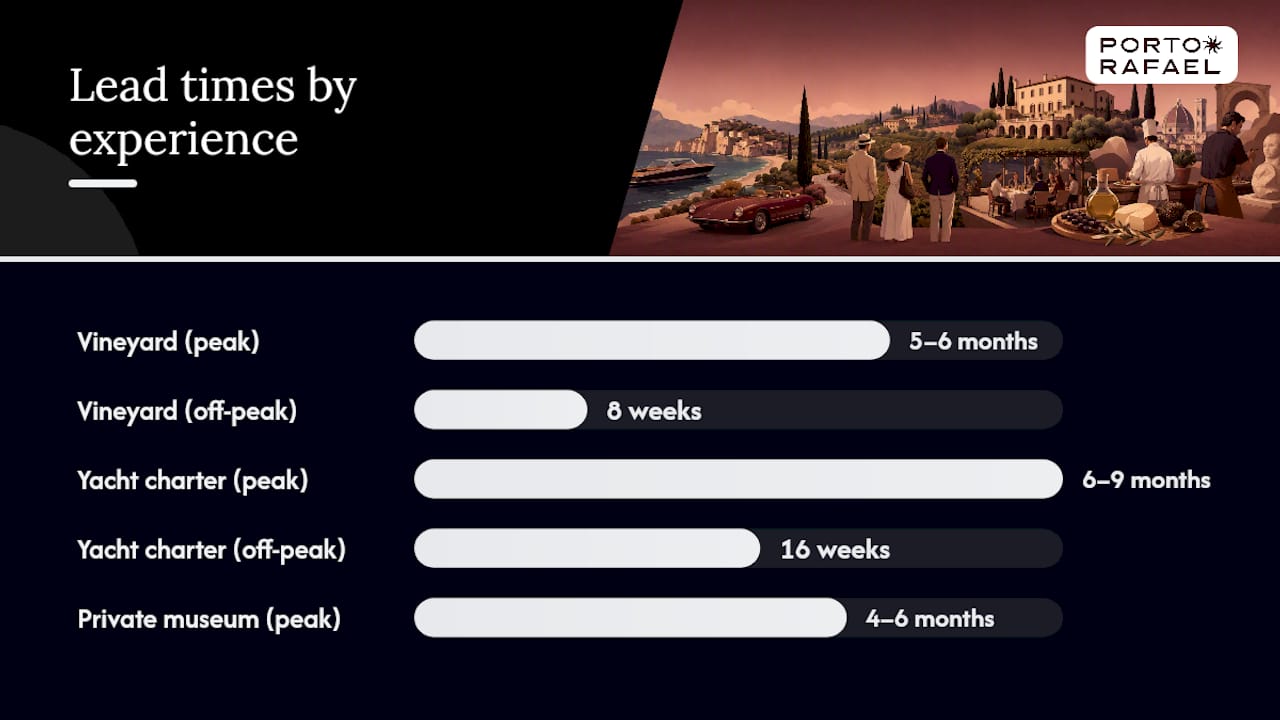
Lead time is often the biggest determinant of client satisfaction: for peak windows, plan 6–9 months ahead; off-peak and many villa bookings are better secured 8–16 weeks in advance.
Personalisation levers that transform a trip from pleasant to indelible
The practical choices that separate a memorable excursion from a merely comfortable one are specific and repeatable. Luxury travel built around emotional design asks not only where the guest goes but how they want to feel when they arrive.
- Private vineyard dinner in Tuscany or Sardinia. An after-hours tasting with the winemaker, followed by a table set among the vines at dusk, is available only through direct relationships with the estate. No booking platform lists it.
- Private Vespa route on the Amalfi Coast. A local guide, a curated route avoiding tourist traffic, and a stop at a family-run limoncello producer create a rhythm that no group tour can replicate.
- Off-market chef's table in Rome. Several Roman chefs host private dinners in their home kitchens for guests introduced by trusted contacts. The experience is invisible to standard search.
- Artisan workshop in Sardinia. A morning with a Gallura cork craftsman or a filigree jeweller in Tempio Pausania offers cultural depth that no museum visit matches.
At Portorafael, the village's own assets extend these possibilities naturally. Private boat excursions departing from Porto Rafael reach sea caves and coves that are inaccessible by road. The Solaz Restaurant can be briefed to build tailored menus around a guest's dietary profile and flavour preferences, drawing on Gallura's seasonal produce. Hotel La Piazza provides a setting for private events, from intimate celebrations to corporate gatherings, with the village's characteristic calm as the backdrop. Rafael's Bar & Lounge offers a more relaxed but equally curated space for aperitivo hours or late-evening gatherings shaped around the group's pace.
How to vet hotels, suppliers, and logistics partners
Supplier quality is the single variable most likely to undermine an otherwise well-designed itinerary. A practical vetting checklist reduces that risk significantly. For guidance on elevating guest service during bespoke events, the principles of high-touch hospitality apply equally to excursion suppliers.
- Reputation. Seek references from other travel advisors or luxury operators, not just guest reviews. A supplier who cannot provide two professional references is not ready for a high-stakes booking.
- On-site inspection or verified photography. For any venue or accommodation, request recent, unedited photographs or a video walkthrough. For high-value bookings, an in-person inspection is worth the cost.
- Insurance and licensing. Confirm public liability insurance, maritime licensing for boat operators, and any Comune or Soprintendenza permits required for the specific experience.
- Written policies. Cancellation terms, force majeure clauses, and substitution rights must be in writing before any deposit is paid.
- Sample run-through. For complex logistics (multi-vehicle transfers, private dinners in remote locations), ask the supplier to walk through the operational sequence. Gaps in their answer reveal gaps in their preparation.
Red flags in Italian suppliers: no written cancellation policy, references that cannot be independently verified, vague invoicing that does not itemise services, and reluctance to confirm permits in writing.
Must-ask contract clauses: cancellation flexibility with staged refund milestones, exclusivity and indemnity for curated access experiences, timing service-level agreements with defined escalation steps, and a named replacement-supplier clause for critical services.
Cost drivers, budgeting, and realistic lead times
Planning fees are often structured as a small percentage of total trip cost, or as a weekly rate plus a per-day fee, and framing them this way helps clients understand the value relative to the overall investment. A planner's fee on a high-value trip is typically far smaller than the cost of a single poorly chosen supplier or a missed permit.
Sardinia's private excursion market has grown by roughly 63%, which means the best local guides, boats, and exclusive experiences are now booked earlier than ever. Lead time is no longer a courtesy; it is a competitive necessity.
Managing the experience on the day
The best-designed itinerary still requires active management once the trip begins. A single point of contact, known to both the guest and every supplier, is the most important structural decision in on-trip management. That person should have direct lines to every supplier, a printed contingency plan for the three most likely disruptions (weather, late flights, permit issues), and the authority to make decisions without escalating.
- Pre-booked buffers. Build 20–30 minutes of unscheduled time between every major activity. Guests rarely notice it when things run smoothly; they notice immediately when there is no slack.
- VIP handoffs. At each supplier transition, the outgoing contact should introduce the incoming one by name, in person where possible. Anonymous handoffs feel impersonal and signal poor coordination.
- Discreet local contacts. Maintain a list of trusted local fixers for medical, legal, or logistical emergencies. These contacts should be briefed before the trip, not sourced during it.
- Daily check-in. A brief end-of-afternoon conversation with the guest confirms the next day's plan and surfaces any shift in mood or preference. Guests who feel heard rarely complain; guests who feel unheard rarely return.
- Lessons learned. After every trip, document what worked, what required improvisation, and which suppliers performed above or below brief. This record becomes the most valuable asset for the next bespoke itinerary.
For customising guest experience at luxury events, the same principles of anticipation and discreet responsiveness apply whether the occasion is a private dinner or a multi-day excursion.
Practical toolkit: sample client brief and Porto Rafael itineraries
Reusable client brief template
| Field | Detail to capture |
|---|---|
| Travel party | Names, ages, relationship, any mobility or accessibility needs |
| Dates and duration | Confirmed or flexible; blackout dates |
| Budget range | Total trip budget and any category limits (accommodation, dining, transport) |
| Pace preference | Slow (1–2 activities per day) / Moderate (3–4) / Active (5+) |
| Cultural interests | Art, history, food, nature, sport, artisan crafts, music |
| Cuisine and dietary | Allergies, intolerances, preferences, wine knowledge level |
| Transport comfort | Boat, helicopter, road, train; any phobias or restrictions |
| Non-negotiables | Experiences or conditions that must be included or avoided |
| Special occasion | Anniversary, honeymoon, birthday, celebration, corporate |
| Past trips | One trip that exceeded expectations; one that disappointed |
| Special requests | Privacy level, photography preferences, language needs |
One-day sample itinerary: Porto Rafael, Gallura
Morning. Depart Hotel La Piazza by private boat for a guided coastal excursion along the Gallura shoreline, visiting sea caves and secluded coves accessible only by water. The skipper is briefed on the group's pace and can anchor for swimming at the guest's discretion.
Midday. Return to Porto Rafael for a private lunch at Solaz Restaurant, with a menu pre-agreed with the kitchen to reflect the group's dietary profile and seasonal Sardinian produce.
Afternoon. A guided visit to a nearby Stazzo heritage farmhouse, where a local artisan demonstrates traditional Gallura crafts. The visit is arranged privately, outside public opening hours.
Evening. Aperitivo at Rafael's Bar & Lounge, followed by a private dinner on the Hotel La Piazza terrace as the sun drops behind the Maddalena archipelago.
Three-day turnkey itinerary: Porto Rafael base
- Day 1. Arrival, room orientation, private welcome dinner at Solaz Restaurant with a tailored tasting menu.
- Day 2. Full-day private sailing excursion; lunch on board; afternoon at a secluded cove; evening at Rafael's Bar & Lounge.
- Day 3. Morning artisan workshop in Tempio Pausania; return to Porto Rafael for a farewell lunch; private transfer to airport.
This template adapts readily: a honeymoon replaces the artisan workshop with a private sunset cruise; a family trip adds a morning snorkelling lesson; a corporate group replaces the farewell lunch with a private event at Hotel La Piazza.
How to write a supplier brief that actually gets results
A booking confirmation is not a brief. A brief tells the supplier who the guest is, what matters to them, and what success looks like, so the supplier can make decisions on the day without calling you.
A strong supplier brief includes: guest names and a one-sentence profile ("a couple celebrating their 25th anniversary; she is a keen cook, he prefers to be outdoors"), the confirmed schedule with timings and buffer allowances, dietary and accessibility requirements, the tone the guest expects (formal, relaxed, educational, playful), two or three things the guest has specifically mentioned wanting, and a direct contact number for the on-trip coordinator.
Send the brief at least 72 hours before the experience. Follow up with a call the day before for any experience involving private access, permits, or complex logistics. Suppliers who receive a thorough brief perform better, not because they needed the information, but because the brief signals that the client's standards are high and the relationship is worth protecting.
Common customisation challenges and how to resolve them
The client cannot articulate what they want. This is the most frequent design challenge, and it is rarely the client's fault. Most people have not been asked the right questions. Use visual prompts (three images that represent the feeling they want), reference trips they have loved, and present two contrasting concept options rather than asking for a blank-canvas brief.
Permit delays for private site access. Italian bureaucratic timelines for Soprintendenza approvals can slip by weeks. Always apply for permits 30 days earlier than you think necessary, and build a confirmed alternative experience into the itinerary for every permit-dependent moment. Never present a permit-dependent experience as confirmed until the written approval is in hand.
Supplier substitution at short notice. A key supplier cancels 48 hours before the experience. The solution is structural: every itinerary should carry a named backup supplier for any experience that cannot be replicated easily. Establish that relationship in advance, not in a crisis.
Pacing disagreements within a travel party. One guest wants to fill every hour; another needs recovery time. The brief should capture individual preferences, not just the group's, and the itinerary should build in opt-out moments where one guest can rest while another continues an activity.
Budget creep during design. Bespoke itineraries tend to grow as clients discover what is possible. Set a clear budget ceiling at the concept stage and present any additions as trade-offs ("adding the helicopter transfer means removing the private vineyard dinner to stay within budget"), not as upsells.
Legal and regulatory considerations for luxury excursions in Italy
Italy's regulatory framework for private and exclusive experiences is specific, and non-compliance can result in a cancelled experience, a fine, or reputational damage to the operator.
Private site access. Access to state-owned archaeological sites, national park areas, or protected coastal zones outside public hours requires written authorisation from the relevant Soprintendenza Archeologia, Belle Arti e Paesaggio or the Parco Nazionale authority. Applications must be submitted with a detailed description of the proposed activity, the number of participants, and the operator's insurance documentation.
Maritime licensing. Private boat charters in Italian waters require the vessel operator to hold a valid Patente Nautica and the vessel to carry current registration and insurance under Italian maritime law. Guests should request copies of these documents before departure.
Event licensing. Private events on public land, including beaches, piazzas, and public gardens, require a Comune permit (Autorizzazione Comunale). Processing times vary by municipality but typically run 2–4 weeks. Events on private land do not require a Comune permit but may still require noise or catering licences depending on scale.
Food and beverage regulations. Private dining experiences hosted outside a licensed premises (a vineyard, a private villa, a boat) must be operated by a licensed catering company or a licensed restaurateur. An unlicensed private chef serving food for payment operates outside Italian food safety law (D.Lgs. 193/2007).
Data protection. Guest profiles and preference data collected during the discovery process are subject to GDPR as implemented in Italy under D.Lgs. 196/2003 (as amended). Store client data securely, obtain explicit consent for its use, and do not share it with suppliers beyond what is operationally necessary.
This section provides general information about Italian regulatory requirements. Confirm current rules with a qualified Italian legal professional or the relevant authority before proceeding.
A Porto Rafael perspective on crafting memorable bespoke excursions
The 63% growth in private excursions across Sardinia is not simply a market trend. It reflects something more fundamental: affluent travellers have grown tired of experiences that are merely expensive and have begun seeking experiences that are genuinely rare. The difference is not price. It is access, relationship, and the quality of attention brought to every detail.
What Porto Rafael's position in Gallura makes possible is the kind of local knowledge that cannot be purchased through a booking platform. The relationships with Sardinian winemakers, artisans, and maritime guides that make a private excursion feel genuinely exclusive have been built over years, not assembled for a season. That depth of connection is what separates a curated experience from a premium product.
The practical implication for anyone commissioning a bespoke excursion in Sardinia is this. Lead times are tightening, the best local partners are booking further ahead than ever, and the discovery conversation—the one where you learn what the guest actually wants rather than what they think they want—is now the most valuable hour in the entire design process.
Portorafael: commissioning bespoke excursions in Sardinia
Portorafael offers a rare combination of on-site assets and local relationships that makes it one of the most capable bases for commissioning tailored luxury trips in Gallura. Private boat excursions and sailing experiences depart directly from Porto Rafael, reaching coastline that remains inaccessible to most visitors. The Solaz Restaurant accepts advance briefs for tailored menus, private dining arrangements, and group celebrations. Hotel La Piazza provides venue space for private events, and Rafael's Bar & Lounge can be configured for exclusive aperitivo or evening gatherings.
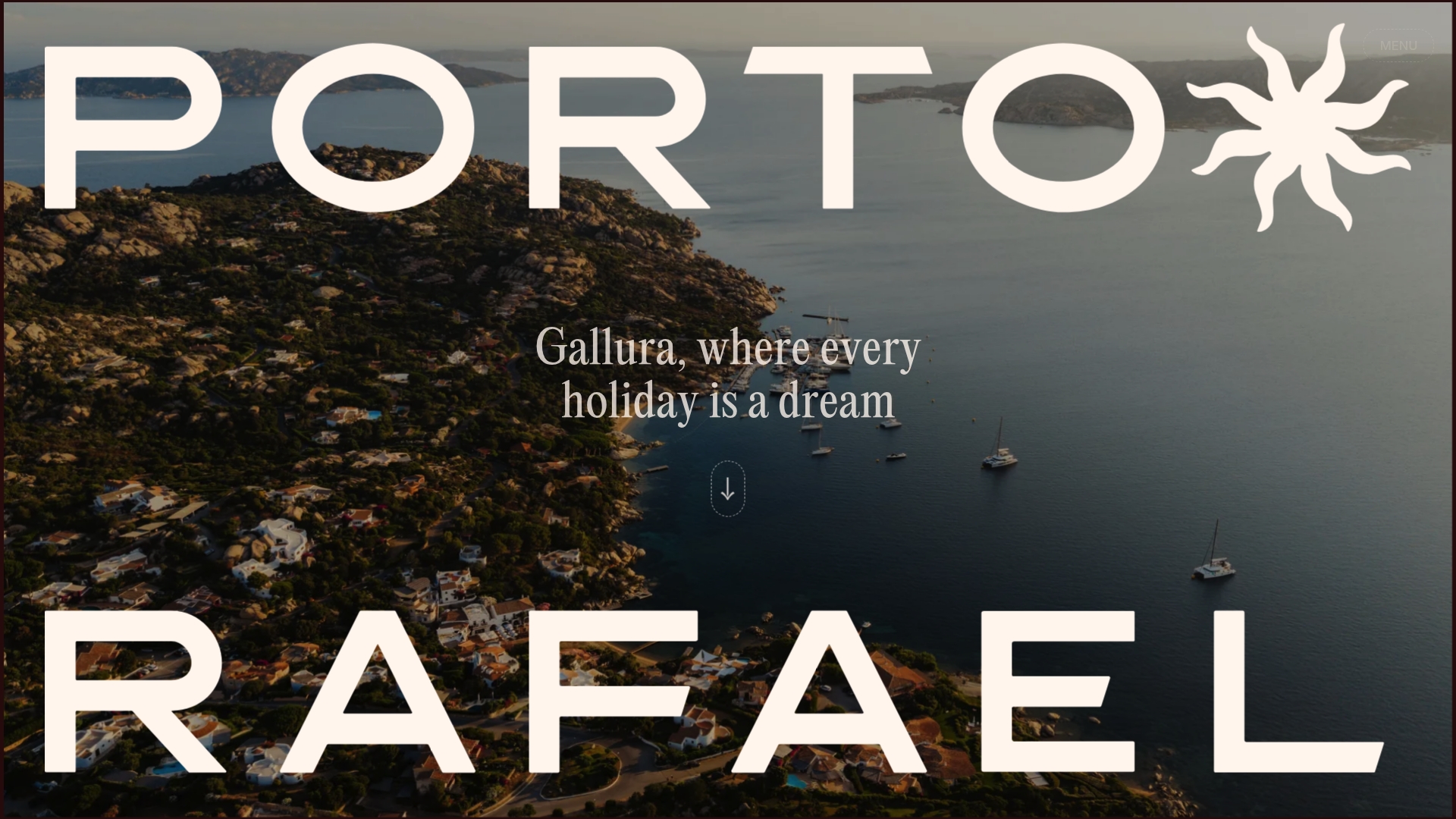
To commission a bespoke excursion, the recommended first step is a direct enquiry through Portorafael's website, where the team can confirm availability, preferred lead times (typically 4–8 weeks for most experiences, longer for peak-season yacht weeks), and the deposit structure. The single point of contact throughout the process is Portorafael's concierge team, who hold the local relationships that make exclusive access possible.