

The fastest routes to Sardinian language learning for UK learners are: download the uTalk Sardinian course for immediate vocabulary practice, contact the Istituto Camillo Bellieni to join their free A1 course (available online via Skype), or book a trial session with a native-speaker tutor on italki or Preply. Your immediate next step: decide whether you want structured grammar (A1 institute course), flexible conversation practice (private tutor), or self-paced vocabulary building (app), then visit the relevant platform today with your email address and a note of your current level ready.
For UK learners, all of these routes are genuinely accessible. The Istituto Camillo Bellieni's Lingua Sarda A1 course runs in-person in Mara and online via Skype, making it reachable from anywhere in Britain. YouTube lesson series offer free listening exposure at any hour. Community and municipal courses in Sardinia itself run seasonally, typically 30 hours, and are worth monitoring if you plan a visit.
Where can UK learners find Sardinian classes?
Sardinian is a minority language with a devoted community of teachers and cultural organisations behind it. The options below are realistic and UK-accessible.
- Language apps: uTalk offers a dedicated Sardinian module for mobile vocabulary and phrase practice. It is the most immediately accessible starting point for absolute beginners.
- Specialist institutes: The Istituto Camillo Bellieni in Sassari runs structured courses including a published A1 syllabus. The course is listed as free and participates online via Skype, making it fully accessible to UK learners across time zones.
- Municipal and library courses: Public programmes in Sardinia, such as those run by the Città Metropolitana di Cagliari and the Sistema Bibliotecario Monte Claro, offer 30-hour base and intermediate courses, often free, with a grammar and dictionary supplied to participants. These are primarily in-person in Cagliari, so most relevant for learners planning a stay.
- Private tutor marketplaces: italki and Preply both list Sardinian-competent tutors. italki suits learners who want flexible one-to-one conversation sessions; Preply offers trial lessons and a more structured scheduling system.
- Community and heritage classes: Local Sardinian associations and cultural bodies occasionally run informal classes. The Comune di Quartu Sant'Elena, for example, runs 'Sa lìngua in Quartu' community courses using CLIL immersion methodology across 30 hours. These are worth searching for if you have Sardinian heritage connections.
- YouTube lesson channels: Free video series covering beginner phrases and listening practice are widely available. Search "Sardinian language lesson" and look for structured LESSON 1-style series rather than isolated clips.
As local organisers and journalists note, Sardinian courses are often community-led and culture-centred, so enrolment processes can be informal. Expect to send an email rather than complete an automated online form, particularly for institute and municipal courses.
How to choose the right Sardinian class for your goals
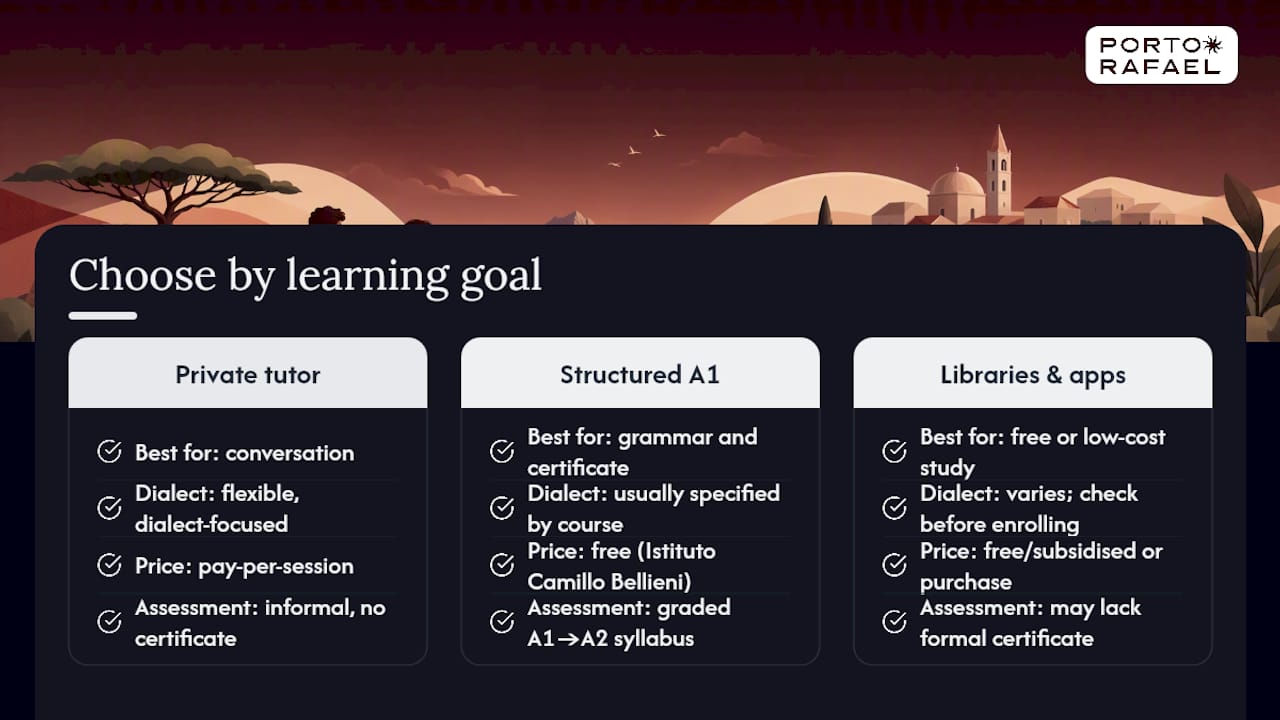
Choose a private tutor for conversation; choose a structured A1 course for grammar, assessment, and a clear syllabus. That distinction shapes everything else.
Format and level. If your goal is to speak with family or use the language during a visit to Sardinia, a tutor on italki or Preply gives you the flexibility to focus on the dialect and vocabulary you actually need. If you want a certificate or a graded progression from A1 to A2, the Istituto Camillo Bellieni's published syllabus is the most structured option currently available to UK learners online.
Dialect. Sardinian has two principal varieties: Logudorese (spoken in the north and centre) and Campidanese (spoken in the south, including Cagliari). Most courses specify which variety they teach. Ask before enrolling, and match your choice to where you plan to travel or who you plan to speak with.
Price and availability. The Istituto Camillo Bellieni's A1 course is listed as free. Municipal library courses in Sardinia are free or subsidised but require in-person attendance. Private tutors on italki and Preply charge per session, with rates varying by tutor experience. uTalk operates on a one-off purchase or subscription model.
Red flags to watch for. No published syllabus, no native-speaker option where dialect matters, and no clear cancellation or refund policy are all reasons to ask questions before paying. A reputable provider will state the course level, the number of hours, the teaching methodology, and what happens if you need to withdraw.
Questions worth asking any provider:
Before signing up, confirm the course level and whether it aligns with A1/A2 frameworks. Ask whether the tutor or instructor is a native speaker of Sardinian. Check the class size: the Sardegna Biblioteche library courses cap enrolment at 30 participants, which gives a useful benchmark for what a manageable group looks like. Clarify the refund policy and whether a trial session is available before committing to a full course.
Step-by-step: how to enrol in Sardinian language classes
Enrolling via a language app (uTalk)
- Visit utalk.com/store/sardinian and create a free account.
- Search for the Sardinian language module and select your purchase or subscription option.
- Download the app on iOS or Android and begin the first vocabulary unit.
- Set a daily reminder for 10–15 minutes of practice to build a consistent habit.
Enrolling with the Istituto Camillo Bellieni
- Visit the Lingua Sarda A1 course page and note the next intake dates.
- Send an email to the institute using the contact details on the course page. Subject line: "Iscrizione Corso Lingua Sarda A1 – Online (Skype)."
- State your name, your current level (absolute beginner or prior exposure), and confirm you will participate via Skype from the UK.
- Ask for the course schedule, the Skype link or meeting ID, and any materials you need to download in advance.
- Confirm the cancellation policy in writing before the course begins.
Booking a private tutor (italki or Preply)
- Create an account on italki or Preply using your email address.
- Search for "Sardinian" or "Sardo" in the tutor search field. If results are limited, search for tutors listing Sardinian as a spoken language alongside Italian.
- Read tutor profiles carefully: check for native-speaker status, stated dialect, and student reviews.
- Book a trial or introductory session before committing to a package. On Preply, trial lessons are a standard feature; on italki, look for tutors offering a discounted first session.
- Set up your video call software (Zoom, Skype, or Google Meet) and test your microphone and camera at least 30 minutes before your first lesson.
- Check the platform's refund policy for unused lesson credits before purchasing a bundle.
Joining a community or municipal course
- Search for Sardinian language courses run by local cultural associations, libraries, or municipalities, particularly if you are planning a visit to Sardinia.
- Contact the organiser by email, stating your level and preferred dates. These courses often have limited places and seasonal intakes.
- Confirm whether the course is in-person only or has an online participation option.
- Ask about any registration deadline, materials provided, and whether a final assessment is included.
Pro Tip: For online institute courses, always test your Skype or video connection with a friend the day before your first class. A dropped connection in the first session can mean missing foundational vocabulary that the rest of the course builds on.
What do Sardinian courses typically cost, and how long do they take?
Price varies significantly by format. The most structured and affordable option for UK learners is the Istituto Camillo Bellieni's A1 course is listed as free, with online participation via Skype. Municipal and library courses in Sardinia, such as those at the Biblioteca Emilio Lussu, run for a substantial duration and are generally free, with a grammar and dictionary supplied to participants.
Private tutors on italki and Preply charge per session, with rates depending on the tutor's experience and qualifications. YouTube lesson series are free and open-ended.
On timeline: most learners reaching A1 with weekly study of several hours take a few months of consistent practice. Reaching A2 from A1 typically doubles that, though consistent conversation practice with a native speaker compresses the timeline considerably.
Logudorese or Campidanese: which dialect will your course teach?
Most courses specify which variety of Sardinian they use, and the choice matters more than many learners expect. Sardinian has two principal literary and spoken varieties: Logudorese, spoken across the north and centre of the island, and Campidanese, spoken in the south including Cagliari and its surrounding province. Pronunciation, vocabulary, and some grammatical structures differ between them, enough that a learner who has studied one may find the other initially unfamiliar.
The practical advice is straightforward: match your dialect choice to your contact patterns. If your family connections are in Cagliari or the Campidano plain, choose a Campidanese-focused course. If you are drawn to the Gallura region or the Logudoro heartland, Logudorese is the more natural fit. Courses run by the Istituto Camillo Bellieni and municipal bodies in Cagliari tend to reflect the variety of their region.
If the course dialect does not match your target variety, ask the instructor directly about exposure to the other form. A good teacher will incorporate listening exercises from both traditions and help you build comprehension across varieties. Focusing on conversational practice and colloquial vocabulary, rather than written forms alone, also helps bridge the gap between dialects more quickly than grammar study alone.
Resources to use alongside your Sardinian classes
Combining formal lessons with independent practice is the most reliable way to make progress in a minority language with limited media exposure.
- uTalk Sardinian module: Use it for daily vocabulary reinforcement between lessons. Ten minutes a day on the app consolidates what your tutor or course introduces each week. It is a paid product, available at utalk.com/store/sardinian.
- YouTube lesson series: Search for structured LESSON 1-style Sardinian video series for free listening practice. Watch each video twice: once for comprehension, once while reading any on-screen text aloud. Free and available at any hour.
- Textbooks and grammars: Municipal library courses in Sardinia supply a grammar and dictionary to participants. If you are studying independently in the UK, ask your tutor to recommend a specific grammar reference suited to your dialect.
- Language exchange partners: Platforms such as Tandem or HelloTalk allow you to find Sardinian speakers willing to exchange conversation time. This is free and gives you unscripted, natural exposure that no course can fully replicate.
- Sardinian cultural content: Reading local Sardinian-language news, listening to traditional music, or following cultural organisations on social media builds passive vocabulary and cultural context that accelerates comprehension.
The most productive combination: use the app for vocabulary, YouTube for listening, your tutor or course for grammar and correction, and a language-exchange partner for unscripted conversation.
Why immersion in Sardinia accelerates your language learning
Short immersion stays paired with online study produce faster speaking gains than passive study alone. The mechanism is straightforward: when you are surrounded by a language in its natural setting, you encounter vocabulary in context dozens of times a day, and your brain consolidates it far more efficiently than through drills.
Cultural workshops and community courses in Sardinia reflect this principle directly. The Comune di Quartu Sant'Elena's 'Sa lìngua in Quartu' programme uses CLIL immersion methodology precisely because language acquisition deepens when it is tied to cultural activity rather than isolated grammar exercises. Local organisers consistently emphasise that Sardinian courses are as much about cultural heritage as linguistic competence.
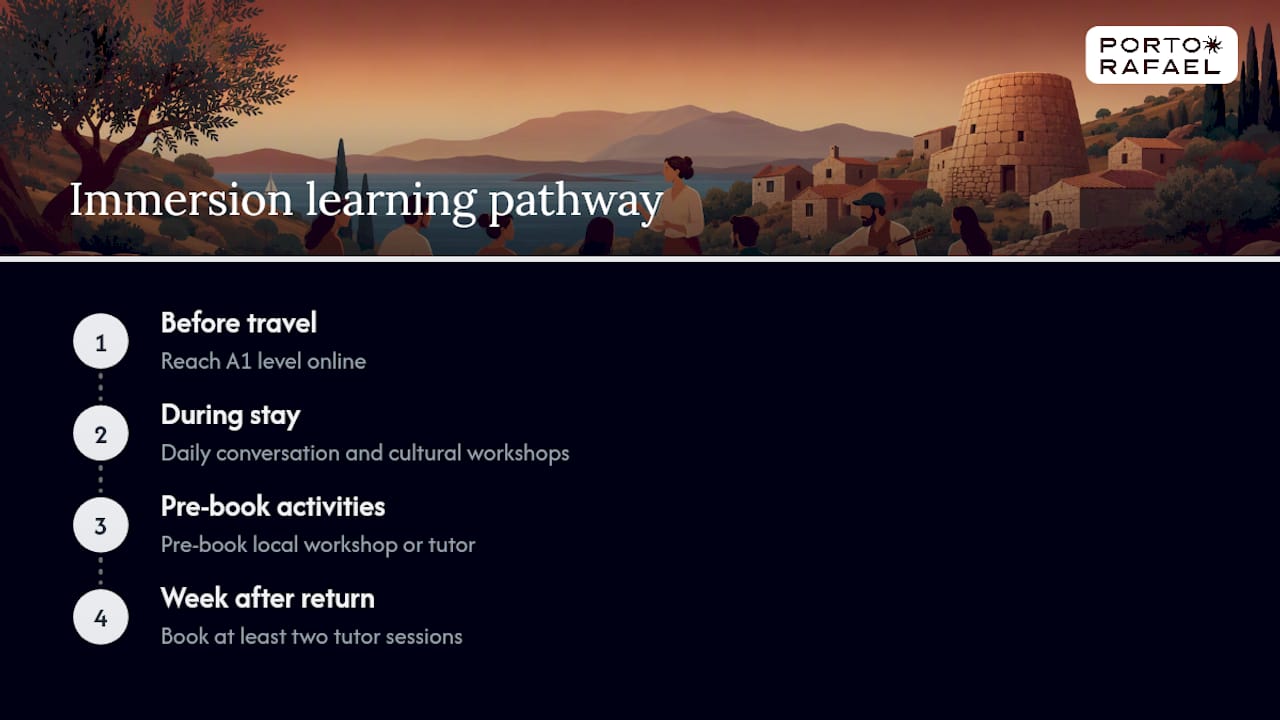
For UK learners, the practical pathway is: reach A1 level online before arriving, then use a stay in Sardinia to consolidate speaking and listening. Even a week of daily conversation with native speakers, combined with cultural activities such as cooking classes, market visits, or guided excursions, can produce gains equivalent to months of remote study. Pairing a stay with a pre-booked local workshop or a few tutor sessions immediately after your return helps retain those gains rather than letting them fade.
Pro Tip: Book at least two tutor sessions for the week after you return from Sardinia. Speaking practice within days of immersion locks in vocabulary and pronunciation before the memory of natural conversation fades.
Portorafael's Sardinian cooking class guide offers a practical example of how cultural workshops can be woven into a stay, giving learners a structured, language-rich activity that goes well beyond a standard holiday.
Why active community practice matters most for minority languages
Passive study is a poor fit for minority languages, and Sardinian is a vivid example of why. The language has no mass-media ecosystem to carry a learner forward: no Sardinian Netflix, no mainstream radio, no daily newspaper with a broad readership. That absence means the usual passive-immersion shortcuts available to learners of Spanish or French simply do not exist.
What does exist is a living community of speakers, cultural organisations, and heritage learners who treat the language as something worth protecting. Joining that community, even from the UK via a Skype course or a tutor session, gives you something no app can replicate: a reason to speak, a person to speak with, and the social accountability that keeps minority-language learners going past the first few weeks.
The practical priorities after enrolment are these: attend every session, speak in every session even when it feels uncomfortable, ask your tutor or instructor which dialect they speak and why, seek out at least one native-speaker conversation partner outside of class, and plan at least one visit to Sardinia within your first year of study. The language is most alive in the places and communities where it has always been spoken.
A stay in Porto Rafael: language learning through living it
There are other routes to Sardinian practice: apps, tutors, online institutes. Porto Rafael offers something different. A stay at Hotel La Piazza in the captivating village of Porto Rafael places you inside the Gallura region, where the rhythms of daily life, the warmth of local hospitality, and the texture of Sardinian culture become the backdrop for genuine language practice.
Combine a stay with a pre-booked local workshop or a cooking class, and the language you have been studying online suddenly has a living context. The Gallura by bike experience, for instance, takes you through landscapes and villages where Sardinian is still spoken as a first language, and the cultural immersion benefits of that kind of encounter are well documented. Porto Rafael's concierge team can help arrange local contacts and workshop opportunities to complement your language study.
To plan your immersion stay in Gallura, visit the Hotel La Piazza booking page and check availability for your preferred dates.
Sources
The following are the primary resources referenced in this article, offering direct access to course pages, enrolment contacts, and supplemental tools.
- Lingua Sarda Livello A1 - Mara e Online - Istituto Camillo Bellieni Sassari
- Sono riaperte le iscrizioni ai corsi di lingua sarda – Sistema Bibliotecario Monte Claro Città Metropolitana di Cagliari
- Citta Metropolitana di Cagliari | Biblioteca Metropolitana Emilio Lussu, ancora aperte le iscrizioni per i corsi di lingua sarda
- Learn Sardinian - Simple, Fun & Easy to use
- Sardinian course in Cagliari: learning the language of Sardinia | Unica Radio (English)