
TL;DR:
- Sardinian cuisine is rooted in land and sea traditions, emphasizing simple, high-quality local ingredients.
- Key dishes include roasted porceddu, pane carasau, malloreddus, and seadas, reflecting the island's diverse landscapes.
- Authentic experience relies on understanding its philosophy of trust in natural flavors and warm community hospitality.
Sardinia is often filed under 'Italian food' by travellers who have never set foot on the island, yet this assumption quietly misses the point. Sardinian cuisine is a world unto itself, shaped by centuries of pastoral life, ancient trade routes, and a fierce pride in local ingredients that owes little to the tomato-rich sauces of the mainland. Sardinian cuisine is characterised by simple preparations using high-quality local ingredients, divided between the rugged interior and the shimmering coast. Understanding this divide is the first step towards appreciating one of Europe's most quietly extraordinary food cultures, and discovering how it sits beautifully alongside a modern luxury experience in Sardinia.
Key Takeaways
| Point | Details |
|---|---|
| Distinct island flavours | Sardinian cuisine celebrates local ingredients and unique traditions set apart from typical Italian food. |
| Sea and mountain divide | Meals reflect the island’s geography: hearty meats and pastas inland, vibrant seafood on the coast. |
| Cultural food experiences | Sardinian meals are as much about community and ritual as they are about taste. |
| Modern culinary innovation | Contemporary chefs reimagine tradition with creative flair, offering both rustic and luxury versions. |
| How to taste Sardinia | Travellers should explore both traditional family-run venues and upscale local dining for the full experience. |
The roots of Sardinian cuisine: Tradition and geography
To understand Sardinian food, you must first understand the land. The island's interior is a world of granite plateaus, cork oak forests, and ancient grazing pastures where shepherds have tended their flocks for millennia. The coastline, by contrast, is a theatre of turquoise water, hidden coves, and abundant sea life. These two landscapes have produced two distinct but complementary culinary traditions, known together as the mari e monti divide, meaning 'sea and mountains.'
Inland Sardinian cooking focuses on lamb, pork, aged cheeses, and hearty pasta, while the coast celebrates seafood, lobster, clams, and fish stews of remarkable depth. Neither tradition is richer than the other. They simply speak different dialects of the same culinary language, rooted in the same respect for local heritage and seasonal produce.
Cultural rituals remain central to how food is experienced on the island. Shared meals at long tables, village festivals honouring patron saints, and the slow rhythms of the shepherd's day all shape what ends up on the plate. Food is never merely fuel here. It is ceremony.
Key ingredients and their significance
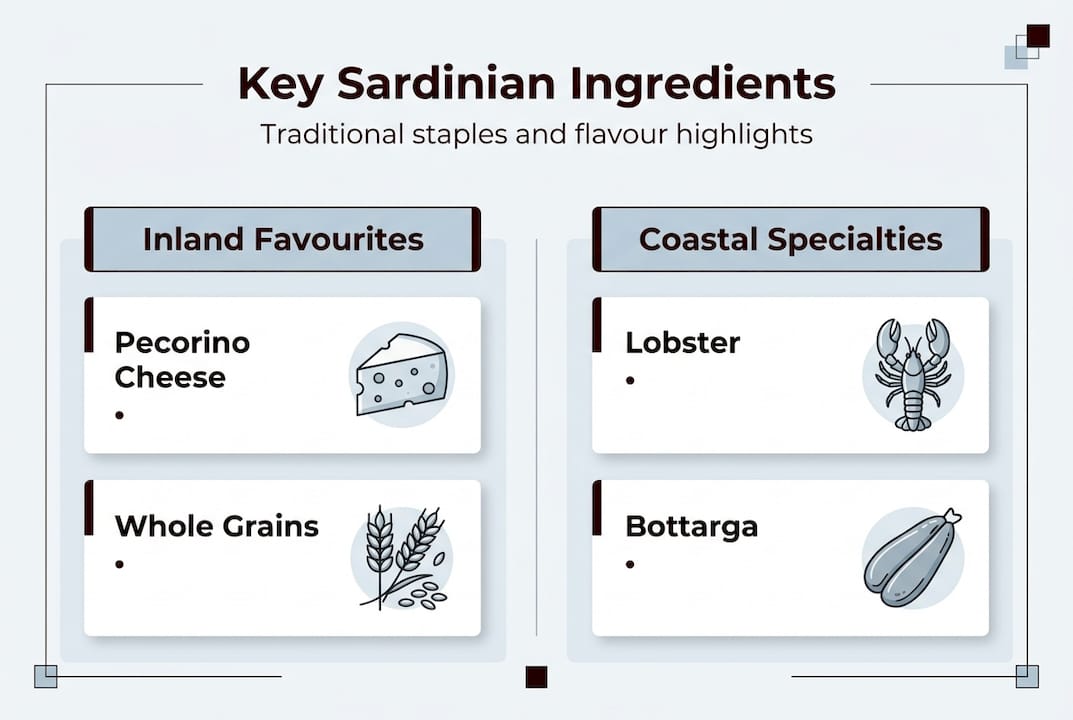
| Ingredient | Origin | Cultural significance |
|---|---|---|
| Pecorino sardo | Inland pastures | Aged sheep's milk cheese, a pastoral staple |
| Extra virgin olive oil | Island-wide | Foundation of nearly every dish |
| Cannonau wine | Inland vineyards | Ancient grape linked to longevity in Sardinia |
| Pane carasau | Island-wide | Paper-thin flatbread, the shepherd's companion |
| Myrtle (mirto) | Island-wide | Used in liqueur and marinades |
| Bottarga | Coastal lagoons | Cured mullet roe, the 'Sardinian truffle' |
The most-used ingredients in Sardinian cooking share a few qualities worth noting:
- Pecorino sardo: Rich in omega-3 fatty acids from grass-fed flocks, it carries a sharp, complex flavour unlike any mainland cheese.
- Cannonau wine: One of the world's highest in polyphenols, often cited in studies on Sardinian longevity.
- Pane carasau: Twice-baked and extraordinarily thin, it travels well and keeps for weeks, a practical necessity born of pastoral life.
- Bottarga: Intensely savoury and umami-rich, grated over pasta or eaten in thin slices with olive oil.
- Myrtle: The island's wild herb, used in everything from roasted meats to the famous mirto liqueur.
For those who wish to go beyond tasting and truly understand these ingredients, a Sardinian cooking class offers a rare and hands-on way to connect with this living tradition.
Signature dishes and flavours you must try
Sardinia's signature dishes carry the weight of centuries. Each one tells a story about the people who created it, the landscape that supplied it, and the occasion that demanded it.
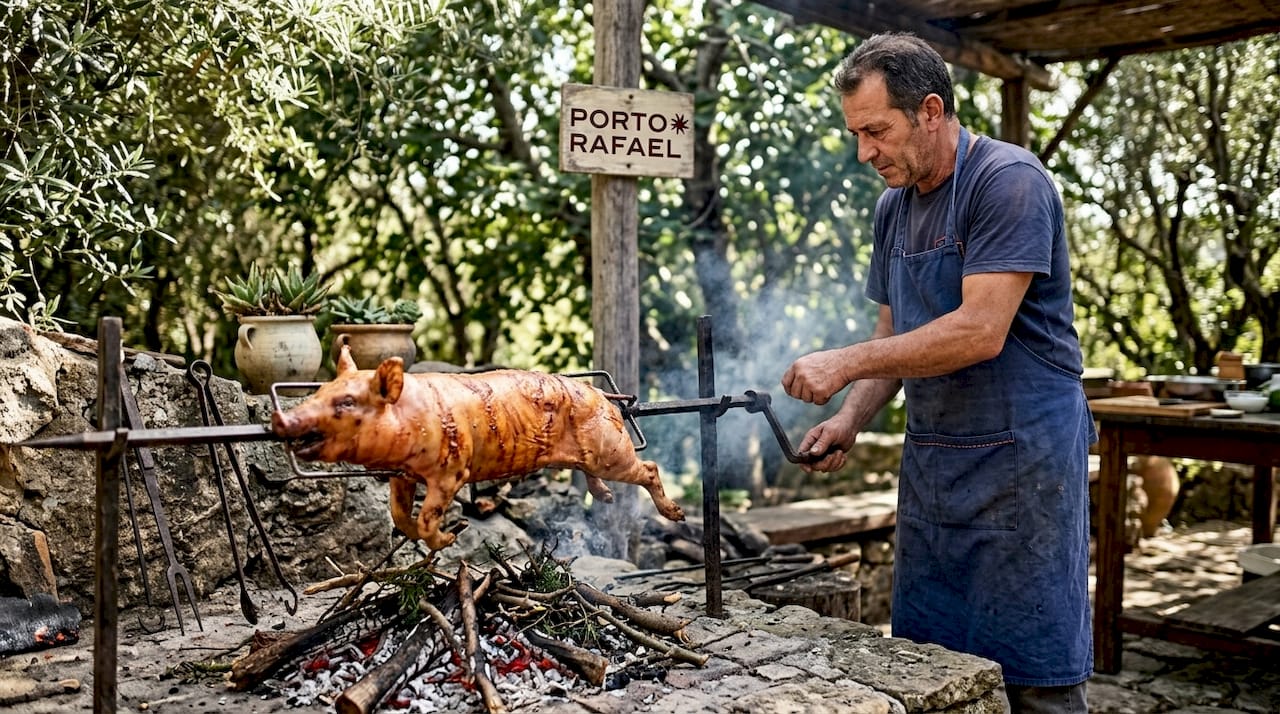
Porceddu is perhaps the island's most celebrated dish: a whole suckling pig slow-roasted over myrtle and juniper wood until the skin blisters to a deep amber and the meat falls apart with the gentlest pressure. It is the centrepiece of every important gathering. Pane carasau appears at almost every table, eaten plain, drizzled with olive oil, or layered with tomato and egg to become pane frattau. Malloreddus, small ridged pasta shells made with semolina and saffron, are served with a slow-cooked sausage ragù that is earthy and warming. Fregula, a toasted semolina pasta resembling large couscous, absorbs the flavours of clam broth beautifully. Bottarga grated over spaghetti with olive oil and lemon is coastal simplicity at its finest. Seadas, large fried pastries filled with fresh pecorino and drizzled with bitter honey, blur the line between savoury and sweet in the most memorable way.
Essential ingredients include sheep's milk pecorino, olive oil, whole grains, Cannonau wine, and myrtle liqueur, and you will encounter all of them in a single well-planned meal.
Inland vs. coastal dishes: A comparison
| Inland | Coastal |
|---|---|
| Porceddu (roast suckling pig) | Aragosta alla catalana (lobster salad) |
| Malloreddus with sausage ragù | Spaghetti alla bottarga |
| Zuppa gallurese (bread and cheese bake) | Fregula with clams |
| Seadas (honey pastry) | Burrida (marinated catfish) |
Pro Tip: Always ask your host or waiter which ingredients are in season. Sardinian cooks take seasonality seriously, and the best dishes are those made with produce harvested that same week.
How to taste a classic Sardinian meal in one sitting
- Begin with antipasti of cured meats, aged pecorino, and pane carasau with olive oil.
- Move to a primo of malloreddus or fregula, depending on whether you are inland or by the coast.
- Choose a secondo of porceddu or fresh grilled fish, accompanied by roasted vegetables.
- Finish with seadas and a small glass of mirto to close the meal in true Sardinian fashion.
For a curated expression of these flavours in a refined setting, gourmet local cuisine awaits at Solaz Restaurant, while artisan gelato and Sardinian cocktails round out the experience beautifully.
Culture on a plate: Rituals, gatherings, and modern interpretations
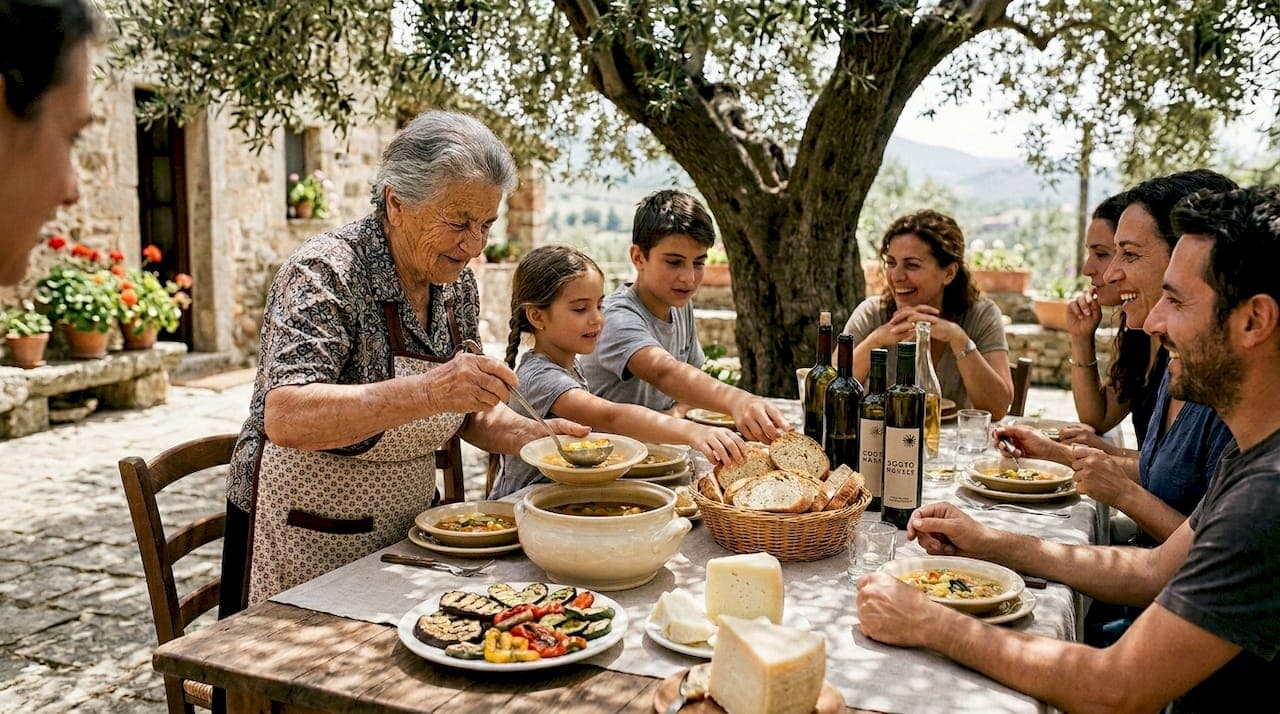
In Sardinia, the table is never just a place to eat. It is where community is affirmed, where stories pass between generations, and where the island's identity is quietly renewed with every shared dish. Food and hospitality are inseparable here, woven into the fabric of daily life in a way that feels both ancient and entirely alive.
Communal meals and festivals remain the heartbeat of Sardinian culture. Consider the key rituals that shape how food is experienced:
- Family Sunday feasts: Long, unhurried meals where multiple generations gather, often lasting the entire afternoon.
- Patron saint festivals (sagre): Village celebrations built around a specific local food, such as roast lamb, fresh pasta, or seasonal seafood.
- Shepherds' gatherings: Informal but deeply traditional meals shared in the countryside, centred on roasted meat, cheese, and bread.
- Harvest celebrations: Marking the grape and olive harvests with communal meals that honour the land's generosity.
The modern dining scene in Sardinia has not abandoned these roots. Instead, it has woven them into something new. A generation of talented chefs, many trained abroad but drawn back to the island, are reinterpreting classic dishes with technical precision and a deep respect for provenance. Modern chefs refine classics without losing their essence, presenting, for example, a deconstructed porceddu in resort settings where the flavours remain faithful but the presentation speaks to a contemporary sensibility.
"The soul of Sardinian cuisine lies not in complexity but in the quality of what the land provides. When you honour that, even the simplest dish becomes extraordinary."
Pro Tip: When dining at a resort or fine restaurant, look for a chef's tasting menu that draws on local producers. These menus often reveal the most thoughtful and surprising interpretations of traditional dishes.
This evolution is part of a broader story about luxury Sardinian experiences that honour tradition while offering the refinement that discerning travellers seek. At its best, it reflects the spirit of genuine Sardinian hospitality, where warmth and generosity are never performed but simply given.
How to experience authentic Sardinian cuisine as a traveller
Knowing what to eat is one thing. Knowing how to find the real thing is another. Sardinia rewards the curious and the patient, and a little preparation goes a long way.
A food-filled day in Sardinia: A practical plan
- Start the morning at a local bar (café) with a warm cornetto and a strong espresso, watching the village come to life.
- Visit a morning market to see the seasonal produce, fresh fish, and local cheeses that will define the day's meals.
- Lunch at a family-run agriturismo, where the menu is fixed, the wine is local, and the welcome is genuine.
- Spend the afternoon exploring a village festival or a local producer, tasting olive oil, honey, or aged pecorino at the source.
- Dine in the evening at a restaurant that names its suppliers on the menu, a reliable sign of authentic intent.
Meals centre on local, seasonal produce with an emphasis on authenticity rather than abundance, and this philosophy is most visible in the agriturismo tradition, where families open their homes and tables to guests.
Practical tips for finding the authentic over the touristy
- Look for menus written in Sardinian dialect or Italian rather than multiple languages from the outset.
- Ask locals where they eat on Sundays. That answer is almost always the right one.
- Avoid restaurants that display photographs of every dish in the window.
- Seek out Porto Rafael gastronomy for a curated selection of venues that balance authenticity with refinement.
- Start the day well with a breakfast in Porto Rafael that draws on local produce and the unhurried pace the island is known for.
For the deepest possible connection to Sardinian foodways, a hands-on cooking class offers something no restaurant visit alone can provide: the chance to make the food yourself, guided by someone who has been making it since childhood.
What most guides miss about Sardinian cuisine
Most food guides approach Sardinian cuisine as a list of dishes to tick off, and in doing so, they miss the point entirely. The real revelation is not the porceddu or the bottarga, remarkable as they are. It is the philosophy behind them: a quiet insistence that the best food requires no disguise.
Unlike many Italian regional cuisines, Sardinian cooking is not built on elaborate sauces or layered technique. It is built on trust. Trust that the pecorino is good enough to eat as it is. Trust that the fish, caught that morning, needs only olive oil and a flame. This is a profoundly different sensibility from the mainland, and it takes a moment to adjust to.
The other thing guides rarely mention is that experiencing Sardinian hospitality is itself a culinary act. When a Sardinian host places food before you, they are sharing something of themselves. The meal is inseparable from the relationship. You cannot fully understand the cuisine without understanding the people who make it, and that understanding only comes when you slow down, accept the invitation, and stay a little longer at the table.
Experience Sardinian cuisine for yourself
Reading about Sardinian cuisine is a pleasure. Tasting it, in the place where it was born, is something else entirely.
Porto Rafael offers a rare setting in which the island's finest culinary traditions come to life. At the Solaz restaurant, seasonal menus celebrate local producers and the mari e monti spirit with elegance and care. For those who wish to learn by doing, a Sardinian cooking class brings the island's recipes into your own hands. Explore the full range of dining and tasting experiences through Porto Rafael gastronomy, and let the flavours of Gallura become a memory you carry long after you leave.
Frequently asked questions
What makes Sardinian cuisine different from other Italian food?
Sardinian cuisine contrasts mainland Italy's sauce-heavy dishes with a rustic simplicity that relies on the inherent quality of local ingredients rather than elaborate preparation or rich condiments.
Which Sardinian dishes should travellers try first?
Porceddu, pane carasau, malloreddus, seadas, and fregula are the essential starting points, as each reflects the island's distinct ingredients and centuries-old cooking traditions in a single, memorable bite.
Where can I experience authentic Sardinian cuisine as a visitor?
Family-run agriturismos and traditional village restaurants offer the most genuine experience, while joining a Sardinian cooking class provides hands-on insight that no menu alone can deliver.
Is Sardinian food healthy?
Traditional Sardinian cooking draws on nutrient-rich ingredients such as grass-fed sheep's milk pecorino, high-polyphenol Cannonau wine, and cold-pressed olive oil, all of which are associated with the island's remarkable longevity statistics.