
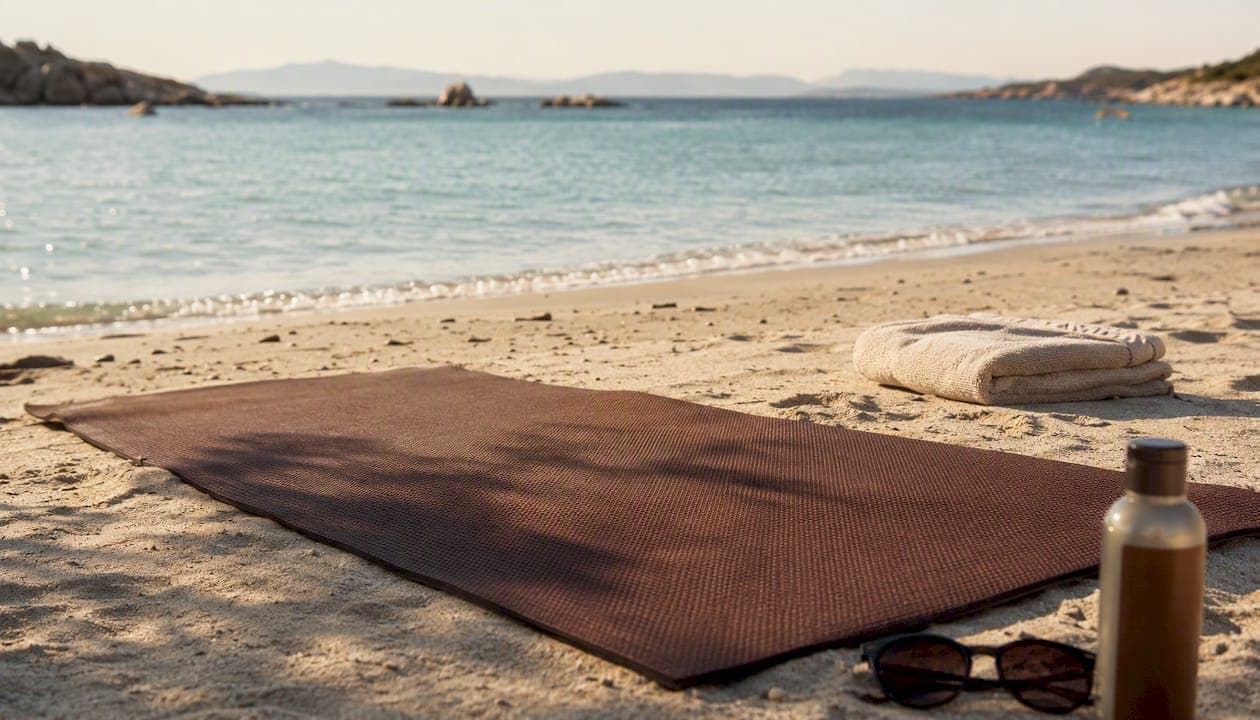
Any qualified instructor with public liability insurance can run a Sardinian beach yoga session in roughly 60 minutes, provided they have checked local permit requirements, chosen a firm-sand spot away from peak crowds, and communicated a clear weather contingency to participants. The logistics are more manageable than many organisers expect, and the reward — practice at the edge of the Mediterranean, in one of Europe's most celebrated Blue Zone regions — is genuinely extraordinary.
Before the day arrives, work through this checklist:
- Pick your beach and confirm access (public stretch or managed concession)
- Contact the local comune to check whether a permit or notification is required
- Confirm your instructor's teaching certification and public liability insurance
- Agree a cancellation and rescheduling policy and publish it at booking
- Compile your kit list and arrange mat hire if needed
- Set your price, open a booking channel, and promote 3–7 days ahead
- Prepare a weather backup (shaded terrace, covered hotel space, or rain date)
How do you plan a Sardinian beach yoga session step by step?
The first decision is format. A drop-in class suits travellers who want flexibility; a private group session suits families or retreat groups who prefer a quieter, more personalised experience. SUP yoga on the water is a third option, popular in the La Maddalena area, though it demands additional equipment and a safety spotter. Settle on format before anything else, because it shapes every subsequent decision.
- Group size: Drop-in classes work well with a moderate group size; private groups of a smaller, more intimate group size feel more intimate and command a higher per-person rate.
- Session length: Professional beach yoga experiences in Sardinia are commonly about an hour long, long enough for a full warm-up, core sequence, and cool-down without overstaying welcome on a busy beach.
- Pricing approach: Charge per person for drop-ins; offer a flat fee for private groups with optional extras (mat hire, SUP boards, post-class refreshments) priced separately.
- Instructor sourcing: Local teachers in north and east Sardinia advertise weekly group lessons and on-demand private sessions near beaches such as La Cinta and Olbia. Bringing your own instructor from the UK is equally viable, provided their certification is recognised and their insurance covers outdoor sessions abroad.
- Booking channel: A simple online form, a WhatsApp reservation link, or a ticketing platform all work. Whichever you choose, state your cancellation terms clearly at the point of booking.
- Transport and meeting point: Specify the exact meeting point with a photo and short route note. Visitors unfamiliar with Sardinian beach access frequently miss sessions because directions are vague.
Pro Tip: Add a Google Maps pin or a What3Words address to your booking confirmation. Listing clear meeting points and short route notes measurably reduces no-shows from visitors who are new to the area.
For a broader view of seaside activity planning in Sardinia, the logistics follow a familiar pattern once the format is fixed.
Which Sardinian beach is right for your yoga session?
Sand type matters more than most organisers anticipate. Packed sand near the waterline gives the firmest surface for standing balance poses; soft, dry sand further up the beach makes single-leg balances genuinely difficult and can frustrate beginners. Test the sand in person before confirming your meeting point, and avoid rocky coves unless the class is small and participants are experienced.
Practical beach options to consider
- Poetto, Cagliari — a long, gently shelving beach with firm sand near the waterline; well served by public transport and with cafés and facilities close by, making it ideal for larger drop-in classes.
- La Cinta, San Teodoro — a quieter stretch popular with local instructors for weekly group sessions; the sand is fine but the northern end tends to be firmer and less crowded in the mornings.
- La Maddalena archipelago — spectacular setting for smaller private groups or SUP yoga; access is by boat, which adds logistical complexity but rewards participants with extraordinary seclusion.
For a full breakdown of Sardinia's sandy beach types and their suitability for different activities, that guide is worth reading before you commit to a location.
Timing your session
- Early morning (early morning hours): The preferred window. Instructors typically run more dynamic flows in the morning to avoid midday heat and peak beach use; the light is also captivating at this hour.
- Early evening (early evening hours): Suits restorative or yin-style classes; temperatures are gentler and the beach empties naturally as day-trippers leave.
- Shoulder seasons (shoulder months): Far less crowded than July and August, with reliable warmth and softer light. High season remains viable if you book a less central spot and start early.
Additional practical checks: note the tide line so your space is not reclaimed mid-session, assess wind exposure (a sheltered cove is worth the extra walk), confirm shade availability for participants who need it, and locate the nearest toilets and café for post-class convenience.
Do you need a permit to hold yoga on a Sardinian beach?
Rules vary by municipality and by the nature of the beach itself, whether it is a free public stretch or a managed concession with a beach club operator. On many public beaches, a small informal class requires no formal permit; on managed or concessioned stretches, you will need the operator's permission at minimum. Organised commercial classes almost always require notification or authorisation from the local comune (municipal office), regardless of beach type.
- Contact the comune: Ask specifically about outdoor commercial activities, time restrictions, and amplified sound rules. Many municipalities have a dedicated Ufficio Sport e Turismo that handles these requests.
- Check beach management consortia: Some beaches in Gallura and the Costa Smeralda area are managed by consortia with their own regulations; a quick call or email clarifies requirements within a day or two.
- Involve the hotel or villa owner: If you are using a private access point or a hotel terrace, coordinate with the property to avoid conflicts with local beach wardens (bagnini).
- Document everything: Obtain written confirmation of any permission granted, note the permit reference number, and keep a contact name and phone number on the day.
Pro Tip: If your session is a one-off private class for hotel guests on a quiet stretch, the risk of enforcement is low — but getting written confirmation from the hotel still protects you if a warden asks questions. A two-minute email is worth the peace of mind.
For a structured approach to event hosting logistics in Sardinia, that workflow covers vendor coordination and permit documentation in useful detail.
What kit do you need for a beach yoga session?
Essential items for beach yoga include a large towel or beach mat, water, sunscreen, and flexible clothing. Beyond the basics, a few organiser-specific additions make the difference between a smooth session and a frustrating one.
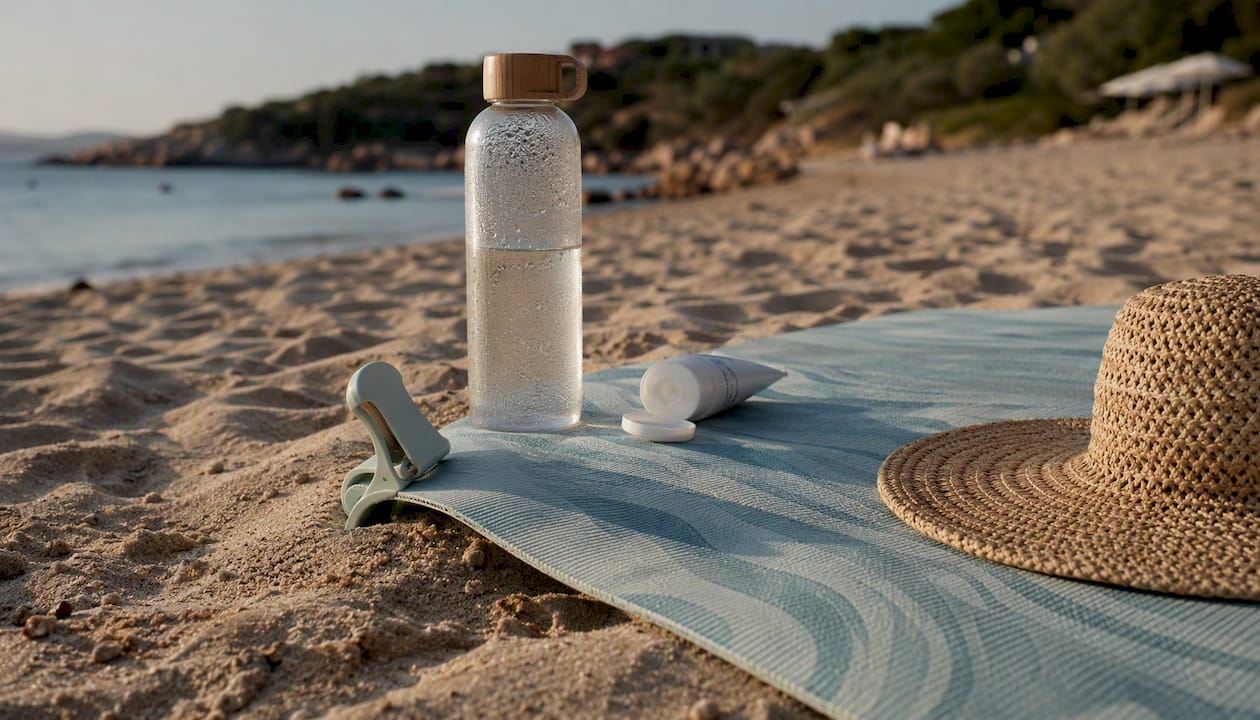
| Item | Purpose | Organiser note |
|---|---|---|
| Large beach yoga mat or towel | Grip and cushioning on sand | Bring spares for hire or loan |
| Heavy towel clips or sand anchors | Stop mats blowing away in wind | Non-negotiable on exposed beaches |
| Water (adequate hydration for participants) | Hydration in Sardinian heat | Remind participants in booking confirmation |
| Sunscreen (SPF 30+) | Sun protection | Advise application before arrival |
| Sunglasses and hat | Post-practice comfort | Particularly important for morning sessions |
| Small first-aid kit | Minor injuries on sand | Plasters, antiseptic, bandage |
| Dry bag | Valuables during SUP sessions | One per participant recommended |
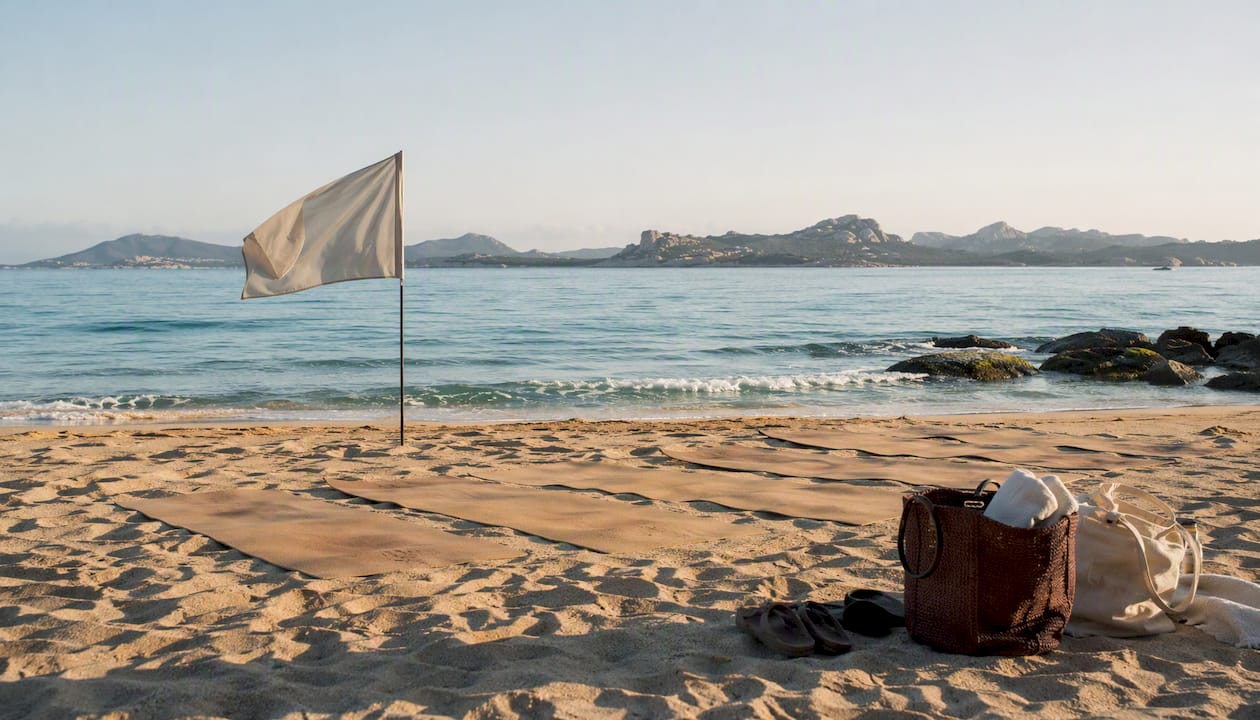
Setup advice: position participants close to the waterline where the sand is firmest, mark a clear meeting point with a visible flag or bag, and designate a small equipment zone for shoes and belongings so the practice area stays clear. For SUP sessions, add flotation aids and run a brief safety briefing before anyone enters the water.
What safety standards should your instructor meet?
The minimum is a recognised yoga teaching qualification and current public liability insurance that explicitly covers outdoor and beach sessions. Ask to see both documents before confirming the booking.
- Teaching certification: Look for qualifications from bodies such as Yoga Alliance (200-hour minimum) or equivalent European standards; for SUP yoga, additional water-safety training is strongly advisable.
- Public liability insurance: This should cover at least appropriate insurance coverage for group classes; confirm it extends to outdoor locations and, if the instructor is UK-based, that it is valid for sessions held abroad in Italy.
- On-site first aid: A small kit is the baseline. Where possible, designate a named first-aid responder within the group and agree a simple emergency plan: the nearest hospital, the Italian emergency number (112), and the nearest guardia medica (local medical post).
- Trust signals to publish: Include the instructor's bio, a summary of their insurance cover, and your cancellation and weather policy in every listing and booking confirmation.
Organisers who publish a clear weather contingency alongside instructor insurance details attract higher trust and better attendance for outdoor classes. These are not bureaucratic formalities; they are the signals that convert a curious enquiry into a confirmed booking.
How should you price and manage bookings for a beach class?
Pricing for a beach yoga session turns on four variables: group size, session type (drop-in versus private), location logistics, and any included extras such as mat hire or SUP board rental.
- Drop-in rate: A per-person fee for a public or semi-public class; typically positioned to feel accessible while covering instructor fees, insurance, and any permit costs.
- Private group flat fee: A single price for the whole group, regardless of exact headcount, with a minimum participant number to protect the instructor's time.
- Tiered extras: Mat hire, SUP board rental, and post-class refreshments each carry their own add-on price; offering minor add-ons can justify a higher per-person rate while improving perceived value.
| Session type | Pricing model | Deposit recommended? |
|---|---|---|
| Drop-in (public beach) | Per person | No (or small holding fee) |
| Private group | Flat group fee | Yes — an upfront deposit is typically required |
| SUP yoga (small group) | Per person, equipment included | Yes — full upfront |
| Retreat add-on | Bundled into retreat package | Per retreat terms |
For payment, a simple online booking form with card payment works well for drop-ins; WhatsApp or phone reservation suits private groups who prefer to speak first. State your no-show and refund policy in plain language at booking: a fair cancellation policy allowing refund if cancelled sufficiently ahead is a widely understood standard that participants find fair.
Where and how do you find participants for a Sardinian beach class?
The most effective channels for reaching participants are those closest to where they already are: hotel concierges, local Facebook groups, and activity platforms that travellers browse on arrival.
- Post in local and expat Facebook groups for the relevant area (Cagliari, Olbia, San Teodoro, Gallura) 3–7 days before the session and again on the morning of the class.
- Approach hotel concierges directly; many are actively looking for curated wellness activities to recommend to guests and will display a flyer or share a booking link.
- List the session on activity platforms that cover Sardinia; a clear description, a photo of the beach, and a precise meeting point are the three elements that convert browsers into bookings.
- Use local noticeboards in villages, surf shops, and cafés near the beach.
- Share photos and short testimonials from previous sessions on Instagram or a Facebook page; visual proof of a real, well-run class is the most persuasive marketing available.
Pro Tip: Write your promotional post in this order: time and location first, then what participants need to bring, then the price and booking link, then the cancellation terms. Participants scan for logistics before they read anything else.
A sample social post might read: "Beach yoga at [location], [day] at 7:30 AM. 60 minutes, all levels welcome. Bring a mat or towel, water, and sunscreen. £[X] per person. Book via [link]. Free cancellation up to 48 hours before." Short, specific, and complete.
Portorafael's guest channels and concierge at Porto Rafael are particularly effective for reaching higher-spend holidaymakers who actively seek organised wellness activities — a distribution route worth exploring for instructors based in Gallura.
A 60-minute beach yoga session plan you can adapt
Beach yoga is suitable for all levels; the sequence below works for a mixed-ability group on a public beach, with notes for morning versus evening energy and for windier conditions.
- Minutes 0–5: Welcome and safety brief. Introduce yourself, confirm the meeting point is clear, point out the first-aid kit, and give a brief note on the surface (sand is uneven — wider stances help).
- Minutes 5–15: Warm-up. Seated or kneeling breath work, cat-cow, and gentle spinal rotations. On windy days, keep participants low to the ground longer than usual.
- Minutes 15–35: Core sequence. Standing poses (Warrior I, II, and III; Triangle) with wider stances than on a studio floor. Morning sessions suit a more dynamic Vinyasa flow; evening sessions benefit from slower transitions and longer holds.
- Minutes 35–45: Balancing poses. Tree pose and Eagle pose; encourage participants to fix their gaze on a point at the horizon rather than the moving water, which disrupts balance.
- Minutes 45–55: Cool-down. Seated forward folds, supine twists, and a brief Savasana. Lay mats parallel to the waterline so participants are not staring into direct sun.
- Minutes 55–60: Closing. A short breathing exercise, a moment of stillness, and a warm close.
Pro Tip: For SUP sessions, compress the standing sequence and extend the seated and kneeling work. The board's instability makes balance poses far more demanding; beginners benefit from spending the first 15 minutes simply finding their footing before any flow begins.
Modifications for soft sand: widen every stance by 10–15 centimetres and cue participants to press through the whole foot rather than the heel alone. For beginners, offer a block or folded towel under the hips for seated poses.
How do you handle bad weather and last-minute changes?
Run two weather checks: one the evening before and one two hours before the session. Look at wind speed (above a wind speed above what is comfortable for classes makes mat anchoring difficult and standing poses uncomfortable), local forecasts via the Italian meteorological service Meteo.it, and sea state for SUP sessions. Professional organisers routinely adapt schedules in real time for weather, wind and sea conditions; flexibility is not a sign of poor planning, it is the mark of an experienced outdoor instructor.
- Publish your cancellation and rescheduling policy at the point of booking, not as an afterthought.
- Communicate changes via the same channel used for booking: WhatsApp group message, SMS, or email, sent at least two hours before the session.
- Backup options: a shaded hotel terrace, a covered courtyard, or a pre-agreed rain date work well; confirm the backup location in your original booking confirmation so participants are never surprised.
- For refunds on organiser-led cancellations, a full refund within 5 working days is the standard that participants expect and that protects your reputation for future sessions.
Pro Tip: On exposed beaches, use heavy towel clips or sand anchors to stop mats blowing away, and position the class on the firm, packed sand closer to the waterline where wind speed at ground level is often lower than further up the beach.
SUP yoga and add-ons that increase appeal
SUP yoga in the La Maddalena area typically runs for around 60 minutes, suits many beginners with proper safety support, and emphasises balance and core strength. It is not appropriate for participants with no water confidence or for days with a swell above 0.5 metres.
- Equipment needed: One SUP board per participant, a paddle (stowed during practice), buoyancy aids, and a dry bag for valuables.
- Staffing: The yoga instructor plus a safety spotter on a kayak or small boat; keep group sizes to a small group size and run a full safety and fall-back briefing before entering the water.
- Sensible add-ons: A guided post-class swim, light refreshments on the beach, a combined boat trip to a secluded cove, or a yoga-plus-local-food-tasting pairing. Each add-on raises the perceived value of the experience and justifies a higher per-person rate.
- Pricing and booking impact: SUP sessions require advance equipment reservation; confirm board availability before opening bookings and build equipment hire into the headline price rather than adding it as a surprise at check-in.
For organisers considering a multi-day outdoor yoga retreat in Sardinia, SUP yoga works particularly well as a mid-week highlight session within a longer programme.
A note from Porto Rafael's Studio team
Organising beach yoga in Gallura rewards those who respect the rhythm of the place. The light at 7:30 AM on a calm June morning, with the Maddalena islands visible across the water, creates a setting that no studio can replicate. What we have observed, time and again, is that the sessions which run most smoothly are those where the logistics were settled well in advance: the permit question answered, the instructor confirmed with insurance in hand, the meeting point photographed and shared. Guests who arrive uncertain of where to stand or what to expect tend to leave underwhelmed, regardless of how beautiful the surroundings are.
The detail that most organisers underestimate is the importance of framing the experience within Sardinia's wider Blue Zone identity. This island's association with longevity, slower living, and restorative practice is not a marketing flourish; it is a genuine cultural context that deepens the meaning of a morning practice by the sea. Communicating that to participants, even briefly, shifts the session from a fitness class to something more memorable.
For those considering hosted sessions at Porto Rafael, the village's concierge team is glad to discuss options, from coordinating permits to connecting visiting instructors with local guest channels.
Porto Rafael: a natural home for beach yoga in Gallura
Porto Rafael offers visiting instructors and group organisers something that independent planning rarely delivers: a complete hosting environment in one of Gallura's most captivating corners. Hotel La Piazza provides refined accommodation for visiting teachers and small groups, while the concierge team can assist with permits liaison, equipment coordination, and connecting classes to the hotel's guest network.
After practice, Solaz Restaurant offers a considered menu of local Sardinian cuisine, and Rafael's Lounge Bar provides a natural setting for an evening post-class gathering. For organisers who want to offer participants a genuinely complete experience — morning yoga, a boat excursion, and a long lunch by the water — Porto Rafael handles the coordination so you can focus on teaching. Enquire directly with the Porto Rafael concierge team to discuss dates, group sizes, and what the village can arrange for your session.
Useful sources and contacts for organisers
- Top Sardinia coastal yoga spots: 2026 guide — a curated overview of the island's best locations for outdoor practice
- Outdoor yoga retreats in Sardinia: your 2026 guide — retreat formats, logistics, and multi-day planning
- Your complete Sardinia event planning guide — vendor coordination, permits, and contingency planning
- Sardinia, Italy — Blue Zones explorations — background on the island's wellbeing identity and its relevance to retreat programming
- Beach yoga safety: 7 rules for ocean-side practice — kit, sand selection, and session safety guidance
- ZONT hotel booking kiosk — transport and transfer booking for groups arriving at Sardinian airports or ports
Municipal contacts: For permit enquiries, contact the Ufficio Sport e Turismo at the relevant comune (Olbia, Arzachena, La Maddalena, Cagliari, or San Teodoro depending on your chosen beach). Contact details are listed on each municipality's official website.
Instructor verification: Always request a copy of the instructor's teaching certificate and their public liability insurance schedule before confirming any booking. For UK-based instructors teaching abroad, confirm that the policy explicitly covers sessions held in Italy.