

TL;DR:
- Booking a boutique hotel involves selecting dates, researching on OTAs, verifying terms with the hotel's website, and asking specific questions before confirming. Timing plays a crucial role, with the 8–14 day window offering potential savings and better availability, especially outside peak seasons. Communicating clearly and politely enhances your chances of securing a preferred room and a smooth stay.
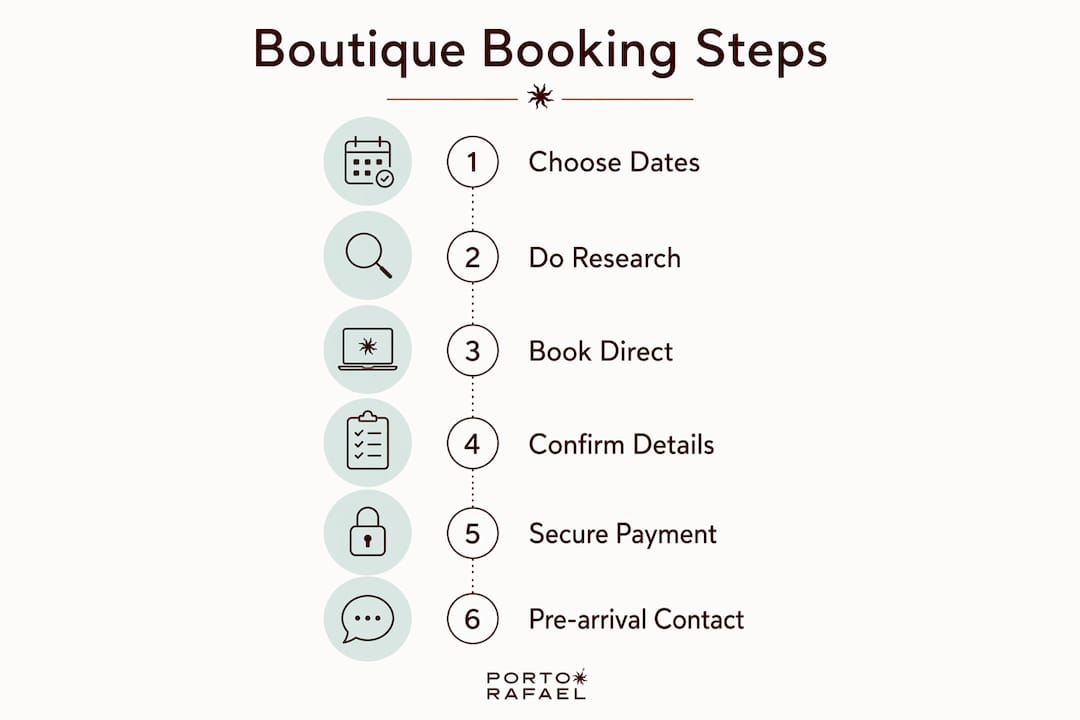
Book a boutique hotel step by step: choose your dates, scan OTAs for breadth and guest photos, verify terms on the hotel's own site, ask a short set of pre-booking questions, then confirm directly to secure the best room and terms.
Your quick checklist:
- Pick travel dates and check for minimum-stay requirements
- Search OTAs (Booking.com, Expedia) for breadth and guest photos
- Cross-check rates on the hotel's direct website
- Compare total price including taxes and tourist fees
- Confirm cancellation, prepayment, and check-in policies
- Ask one concise email with your key questions
- Book and save written confirmation with all terms
Timing note: The Hotels.com Hotel Price Index indicates travellers can potentially save up to 23% by booking 8–14 days before travel compared with months in advance. For boutique properties with limited rooms, that window is worth knowing.
Step 1: How do you choose the right dates for a boutique stay?
Timing shapes everything at a small property. Unlike chain hotels with hundreds of rooms, a boutique with twelve suites fills fast around local festivals, bank holidays, and summer weekends.
The 8–14 day booking window is known as a sweet spot for value, with potential savings of up to 23% compared to booking months in advance, but it only works if the property still has availability. For peak-season coastal destinations, particularly in the Mediterranean, booking several weeks ahead often gives you room selection without paying the premium of booking months out.
Minimum-stay rules are common at boutique properties, with longer stays often required at weekends or during high season, and single-night requests frequently declined. Shifting your arrival by one day, say from Saturday to Sunday, can open availability and sometimes lower the rate.
Practical timing checks:
- Search local event calendars before locking dates; a nearby festival can double occupancy overnight
- Shoulder season (May to June, September to October for Mediterranean stays) often yields better room selection and quieter surroundings
- Midweek arrivals frequently carry more flexibility on minimum-stay rules
- Check whether the property's peak season aligns with school holidays in the UK
Step 2: Where should you look when researching boutique hotels?
The most reliable research pattern is to scan OTAs for breadth, then move to the hotel's own site to verify terms, extras, and the property's character. OTAs aggregate guest photos and honest reviews in one place; the hotel's site reveals the personality, the story, and often the real cancellation terms.

On OTA listings, guest-uploaded photos are more revealing than the hero images the hotel selects. Look for shots of the actual room layout, the breakfast table, the view from the window, and the corridor. Reviews that mention noise, staff by name, or the morning light are worth more than a five-star score with no detail.
Pro Tip: Prioritise guest photos and reviews from the past twelve months. A boutique hotel can change character quickly with new ownership or a refurbishment, so recent images carry far more weight than polished press shots from three years ago.
To verify authenticity, look for an owner narrative on the hotel's website, a named team, and service details that feel specific rather than templated. Soft-branded properties often display a parent brand logo alongside the local name; genuinely independent boutiques tend to lead with their own story. For a deeper sense of what distinguishes authentic boutique hospitality, the boutique hospitality guide at Portorafael is a useful reference.
- Check whether the hotel's website includes a personal narrative or owner biography
- Look for specific service details (named staff, curated local recommendations) rather than generic amenity lists
- Cross-reference the property on Google Maps to confirm the neighbourhood matches the listing description
Step 3: Should you book via an OTA or directly with the hotel?
Direct booking frequently offers better flexibility and sometimes a lower net rate, because hotels avoid OTA commission fees when you book with them directly. That saving does not always translate to a lower headline price, but it often appears as added value: a better room placement, a complimentary breakfast, or a more generous cancellation window.

The practical method is to note the OTA total price (including all taxes and fees), then check the hotel's own site for the equivalent. If the OTA shows a lower public rate, contact the hotel politely and ask whether they can match or improve it. Keep the message brief and factual.
Rate comparison checklist:
- Compare total out-of-pocket cost, not headline room rate
- Note whether the OTA rate is refundable or prepaid; prepaid rates are often lower but carry risk
- Ask the hotel directly whether they offer a rate-match or a direct-booking perk
- Check whether the hotel belongs to a boutique loyalty programme or collection that offers member rates
OTAs occasionally run limited-time promotions that genuinely undercut direct rates. When that happens, book via the OTA but note the booking reference and contact the hotel directly to introduce yourself and state your room preferences. For weekend booking strategies and timing tactics, this practical guide covers the mechanics well.
Step 4: What should you ask the hotel before you commit?
Boutique properties vary widely in their policies, and many booking surprises stem from assuming chain-like standardisation. A small hotel may have no 24-hour reception, a strict 10:00 AM check-out, or a non-refundable deposit policy that differs from what the OTA listing implies.
Non-negotiable policy checks:
- Cancellation window and whether the cut-off is in the hotel's local timezone
- Prepayment requirements and whether the deposit is refundable
- Minimum-stay rules for your specific dates
- Tourist tax (often charged separately at arrival, in the local currency)
- Check-in hours and whether late arrival is possible
- Parking availability and cost
Copy-ready questions to send by email:
- "What is your check-in window, and can you accommodate an arrival at [time]?"
- "Could you confirm the cancellation cut-off and whether it applies in your local timezone?"
- "Are there any additional fees not included in the quoted rate (tourist tax, resort fee, parking)?"
- "Do you have any rooms with [specific preference: high floor, quiet courtyard, sea view]?"
- "Is breakfast included, and if not, what is the cost per person?"
Always request written confirmation of any agreed exception, particularly if the hotel offers a late check-in or a specific room type verbally.
Step 5: How do you finalise the booking securely?
Pay through the hotel's own secure payment page wherever possible, rather than entering card details via a third-party capture form. When a property takes full prepayment, use a credit card: UK consumer protection under Section 75 of the Consumer Credit Act applies to purchases over £100, giving you a route to reclaim if the booking fails.
A valid booking confirmation should include: your name, arrival and departure dates, room type with a clear identifier, total price with taxes itemised, cancellation terms, and a booking reference number. If any of these are missing, request an amended confirmation before travel.
Pro Tip: Save the confirmation email, screenshot the cancellation policy page, and keep any message thread with the hotel in one folder. If a dispute arises at check-in, having the full paper trail on your phone resolves most issues within minutes.
Send a brief, friendly pre-arrival note 3–5 days before you travel. Confirm your arrival time, restate any agreed room preference, and include a contact number for the day of travel. This single message does more for your room placement than any amount of loyalty status.
Step 6: What should you do in the days before arrival?
The final checks are brief but worth doing. Confirm your arrival time with the hotel, clarify the late check-in procedure if you are arriving after the reception closes, and ask about luggage storage if you arrive before the room is ready.
Pre-arrival message checklist:
- Confirm estimated arrival time (ETA) and a mobile number the hotel can reach you on
- Restate any special request in one line (room preference, dietary need, accessibility requirement)
- Ask for the address in full and any specific directions (boutique hotels in historic centres sometimes have unmarked entrances)
- Check whether the hotel has a WhatsApp or direct messaging channel for day-of contact
On arrival, a calm and polite tone works in your favour. Mention your earlier confirmation, state one clear preference rather than a list, and let the team respond. Small properties genuinely value guests who communicate clearly and without pressure.
Common mistakes to avoid when booking boutique hotels
The most frequent error is assuming that boutique means standardised. Industry guides consistently flag that travellers who treat boutique properties like chain hotels, expecting 24-hour reception, flexible late check-out, or a uniform room layout, are the ones most likely to be disappointed.
Mistakes to avoid:
- Booking the lowest-priced room without reading the cancellation terms
- Ignoring guest photos in favour of the hotel's own marketing images
- Assuming breakfast is included when it is listed as an amenity rather than confirmed in the rate
- Overlooking minimum-stay rules and arriving with a one-night plan during peak season
- Sending a long list of requests at booking rather than one concise, polite question
Pro Tip: Use OTAs for research and guest photos, then book boutique stays directly with the hotel. A brief, specific pre-arrival email sent 3–5 days before arrival, explaining a single reason for your room preference, is far more effective than a vague upgrade request at check-in.
Shifting your dates by a single day, particularly avoiding Saturday arrivals, can improve both availability and room placement. Small properties allocate their best rooms to guests who communicate clearly and book with flexibility.
A note on what actually matters when you book boutique
The steps above work. Scanning OTAs for breadth, moving to the hotel's direct site, asking one concise pre-booking question, and following up 3–5 days before arrival: that sequence consistently produces better room placement and fewer arrival surprises than any other approach.
What the steps cannot fully convey is tone. A polite, specific request that explains a single reason ("we would love a quieter room as we are travelling for a milestone birthday") tends to land far better than a list of demands, however reasonable. Boutique operators remember guests who communicate with warmth and clarity, and that memory often shapes the stay before you have even arrived.
The OTA-to-direct workflow is not just about saving money. It is about establishing a direct relationship with the people who will actually look after you.
Porto Rafael: a boutique stay worth booking directly

Portorafael is a rare gem on the Gallura coastline of Sardinia, where Hotel La Piazza, the Solaz Restaurant, and Rafael's Bar & Lounge come together in a captivating village setting above crystal-clear waters. For travellers who have followed the steps above and are ready to apply them, Porto Rafael offers a direct-booking experience that reflects everything a genuine boutique stay should be: transparent policies, curated local experiences, and a team that knows the destination intimately.
Browse the Principe suite for accommodation options and direct availability, or explore the Solaz Restaurant to pair your stay with a table reservation. To begin an enquiry or ask a pre-booking question, the direct request form is the fastest route to a personal response from the Porto Rafael team.
Useful sources and further reading
A short selection of the sources behind the timing data, policy guidance, and booking workflow in this guide:
- Hotels.com 2026 Hotel Price Index — the source for the 8–14 day booking window and potential savings data cited throughout
- Minimum-stay rule explained (Revfine) — clear breakdown of how and why boutique hotels apply minimum-stay requirements
- Booking boutique hotels smarter (Privielle) — practical OTA-to-direct workflow and tone guidance for pre-arrival requests
- Common booking mistakes (Les Boutique Hotels) — industry-facing list of the most frequent errors travellers make at boutique properties
- Hotel reservation tips (Mews) — step-by-step reservation checklist and what a valid confirmation should contain
- Boutique hotel classification guidelines (SLTDA) — an example of how regulatory bodies define and classify boutique hotel standards