
TL;DR:
- Sardinian art has ancient origins, including prehistoric figurines, Nuragic structures, and monumental statues.
- Modern crafts like filigree jewelry and textiles are direct descendants of these deep-rooted traditions.
- Engaging with Sardinian art connects visitors to a living cultural heritage that balances tradition and innovation.
Many visitors to Sardinia leave with a hand-painted ceramic or a piece of silver jewellery, assuming they have touched the surface of something decorative. In truth, they have barely scratched the surface of something ancient and alive. Local Sardinian art is a living cultural language, one that carries the weight of thousands of years of belief, resilience, and identity. This article traces that language from its prehistoric origins through its iconic craft traditions and into its bold modern expressions, offering art lovers and travellers a richer, more meaningful way to experience Sardinia's extraordinary heritage.
Key Takeaways
| Point | Details |
|---|---|
| Ancient origins | Sardinian art mixes prehistoric, Nuragic, and Mediterranean influences to create a unique cultural identity. |
| Symbol-rich crafts | Handmade crafts feature motifs that express beliefs about protection, fertility, and tradition. |
| Living heritage | Local art adapts through innovation, keeping traditions alive and supporting community identity and tourism. |
| Modern evolution | Contemporary artists reinterpret Sardinian motifs, blending old techniques with modern expression. |
The roots of Sardinian art: From prehistory to tradition
To truly understand Sardinian art, you need to travel back further than most people expect. Long before the Romans arrived, before the Phoenicians sailed these shores, communities on this island were already creating objects of profound symbolic power. The origins of art in Sardinia span an extraordinary range of periods, from Upper Palaeolithic beginnings through the Neolithic era and into the magnificent Nuragic civilisation.
The Neolithic period produced some of the island's most evocative early works: small, rounded "mother goddess" figurines carved from stone or bone, representing fertility and the cycles of nature. These were followed by the elegant pottery of the Ozieri culture, characterised by incised geometric designs that already demonstrated a remarkable sense of visual language. Then came the bronzetti, the small Nuragic bronze statuettes that remain among Sardinia's most celebrated ancient artworks.
| Period | Key artworks | Approximate date |
|---|---|---|
| Upper Palaeolithic | Cave markings, early objects | Before 10,000 BC |
| Neolithic (Ozieri) | Mother goddess figurines, pottery | 4,000–3,200 BC |
| Nuragic Bronze Age | Bronzetti, nuraghi architecture | 1,800–500 BC |
| Late Nuragic | Mont'e Prama statues | 9th–7th century BC |
The nuraghi themselves, the massive stone towers that dot the Sardinian landscape, are architectural artworks in their own right. More than 7,000 survive today, each one a feat of dry-stone engineering that speaks to a sophisticated, organised society. Understanding Sardinian architectural history helps place these structures within a broader cultural story that connects landscape, community, and belief.
Perhaps the most astonishing discovery of recent decades is the Mont'e Prama statues: giant stone figures of warriors, archers, and boxers, found near Cabras in western Sardinia. These are the oldest monumental sculptures in the Mediterranean world outside of Egypt, a fact that still challenges many assumptions about ancient Sardinian society.
"The nuraghi and their associated art represent not mere construction, but a civilisation speaking directly across millennia."
Key highlights from Sardinia's prehistoric art tradition include:
- Mother goddess figurines reflecting early spiritual beliefs
- Ozieri pottery with incised geometric decoration
- Bronze statuettes depicting warriors, priests, and animals
- Nuraghi towers as monumental communal architecture
- Mont'e Prama giants as the oldest Mediterranean monumental sculpture
Exploring local Sardinian heritage with this prehistoric context transforms every museum visit into something genuinely affecting.
Iconic Sardinian crafts: Materials, motifs, and meaning
With an understanding of Sardinia's origins, we can now see how ancient influences shape today's crafts. Modern Sardinian handicrafts are not simply folk art for tourist markets. They are the descendants of traditions refined over millennia, using locally sourced materials and motifs that encode belief systems, community identity, and a deep relationship with the natural world.
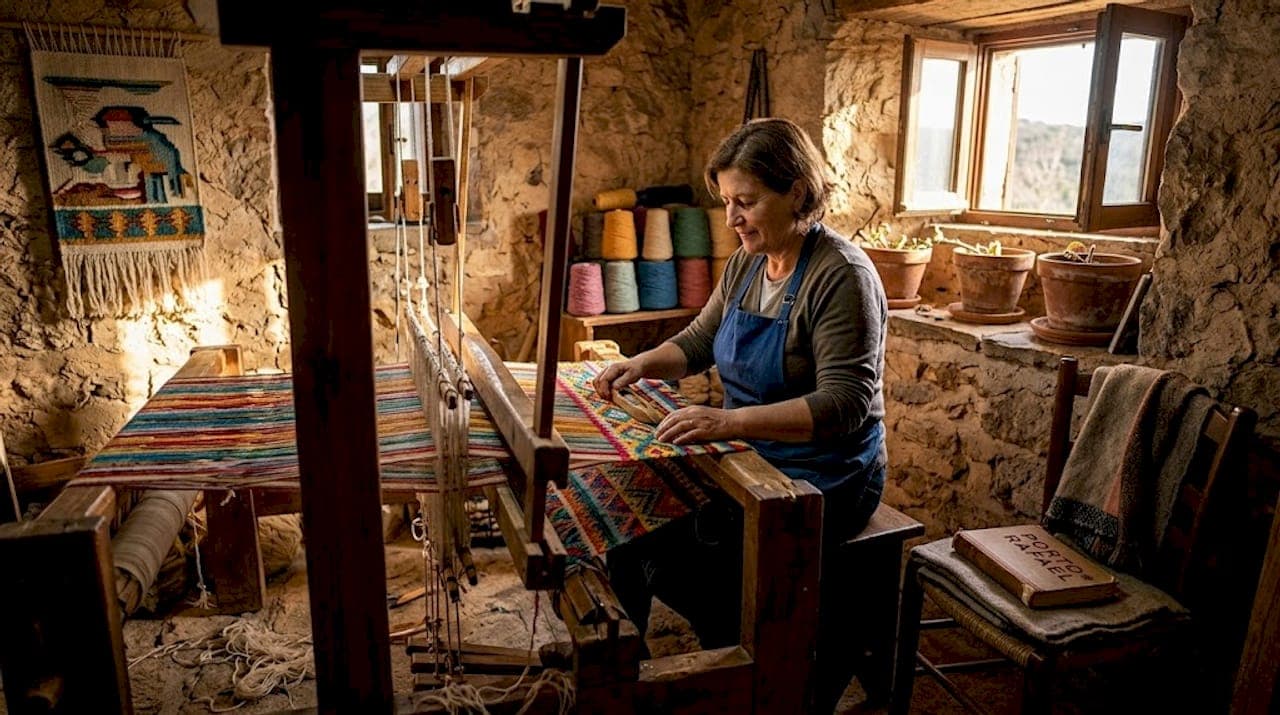
The core materials of Sardinian craft are as rooted in the landscape as the nuraghi themselves: wool from the island's sheep, rushes from coastal wetlands, silver and gold from mining traditions, terracotta from local clay, wood from the maquis, and leather from pastoral life. Each material carries its own regional associations and specialist techniques.
| Craft type | Primary material | Key regions |
|---|---|---|
| Filigree jewellery | Silver, gold | Gallura, Campidano |
| Basket weaving | Rushes, asphodel | Oristano, Nuoro |
| Textiles and weaving | Wool, linen | Nuoro, Ogliastra |
| Ceramics and pottery | Terracotta, clay | Assemini, Oristano |
| Wood carving | Local hardwoods | Barbagia, Ogliastra |
Sardinian craftsmanship incorporates motifs that blend pagan and Christian symbolism seamlessly: stars for guidance, crosses for protection, flowers for fertility, and geometric patterns that echo the Ozieri pottery of five thousand years ago. These are not merely decorative choices. They are a visual vocabulary, one that communicates belonging, protection, and continuity across generations.
Pro Tip: When buying Sardinian crafts, look for the "ISOLA" quality mark, issued by the Sardinian regional authority. It certifies authentic, island-made pieces and distinguishes genuine artisan work from mass-produced imitations.
How to identify an authentic Sardinian craft piece:
- Check for the ISOLA certification label on the item or packaging
- Ask the artisan about the specific materials and regional tradition involved
- Look for slight irregularities, a sign of hand production rather than machine manufacture
- Enquire whether the piece carries specific symbolic meaning or a local story
- Visit established artisan cooperatives rather than generic souvenir shops
Engaging with the makers is itself part of the experience. True Sardinian hospitality means artisans are often willing to share the stories behind their work, turning a purchase into a genuine cultural exchange.
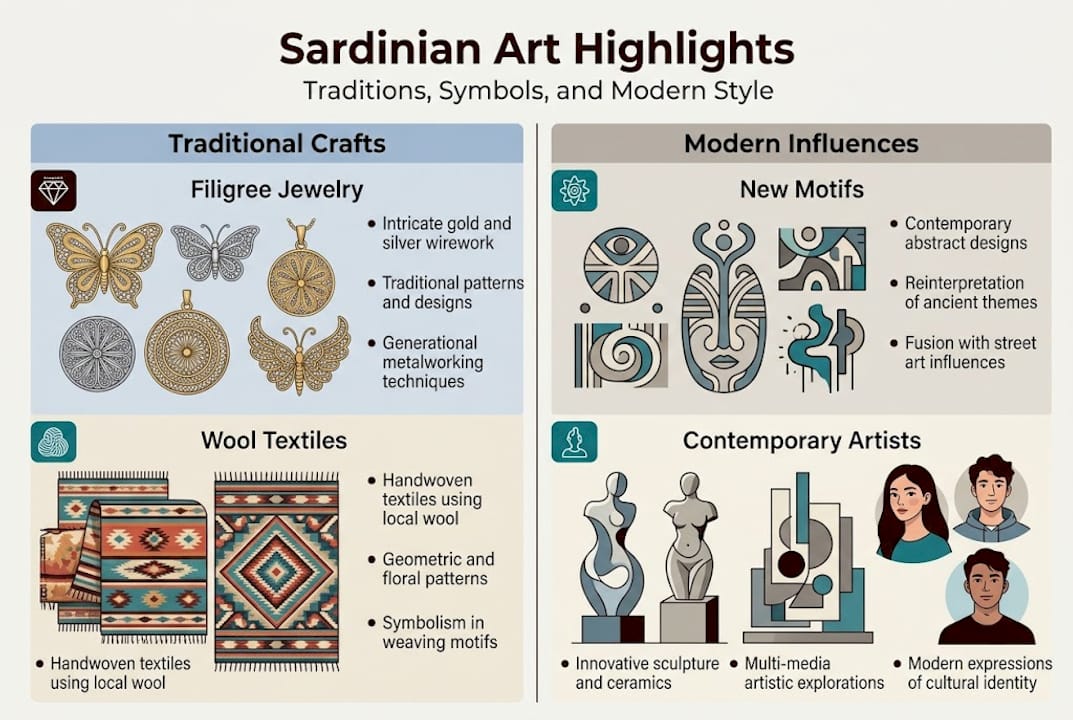
The story of Sardinian filigree jewellery
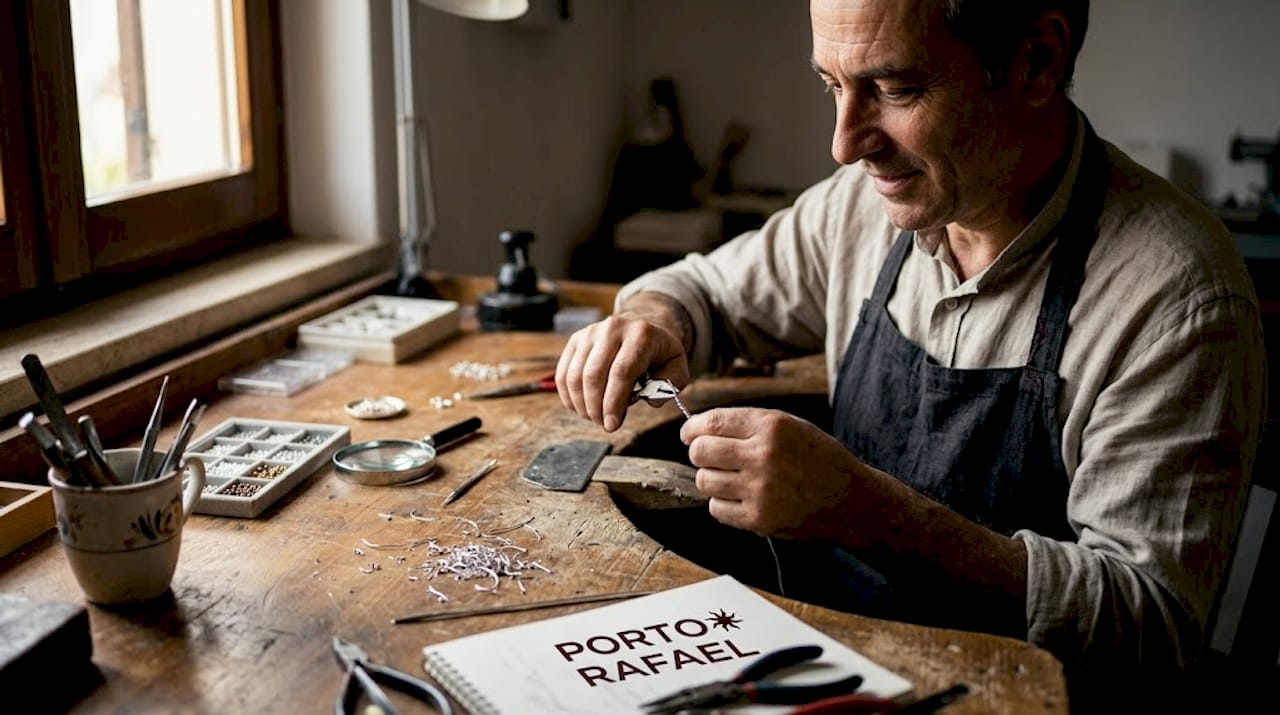
Of all the crafts, Sardinian filigree jewellery stands out for its international renown and symbolic complexity. The technique involves twisting and interweaving fine threads of gold or silver into intricate patterns, often set around a central stone or motif. Its roots stretch from Phoenician to Byzantine influences, making it one of the longest-running craft traditions on the island.
There are two principal working methods. The first, sometimes called the "daybound" approach, involves working with the metal while it remains warm and pliable in direct light. The second, "nightbound" technique, refers to finishing and detailing work done under controlled conditions, often by lamplight, requiring extraordinary precision and patience. Both methods demand years of apprenticeship to master.
Filigree pieces carry layered symbolism. Amulets protect the wearer from the evil eye. Wedding gifts fashioned in filigree signal love, commitment, and family honour. Traditional festival attire incorporates elaborate filigree brooches and pendants, each one specific to a particular village or region, functioning almost like a wearable coat of arms.
Gallura has long been a centre of filigree excellence, with several workshops maintaining the craft across generations. Watching a master artisan at work is one of those rare experiences that connects you directly with a living tradition rather than a museum display.
Notable features of Sardinian filigree:
- Intricate wire-twisting technique with roots in ancient Mediterranean cultures
- Both gold and silver versions, each with distinct regional styles
- Amulet forms including the "sa manu" hand and crescent moon shapes
- Specific brooches tied to individual village festival costumes
- Contemporary designers now reinterpreting filigree for international audiences
Modern jewellers are finding ways to honour the technique while giving it fresh relevance. Clean lines replace some of the denser ornamentation, and new settings introduce filigree motifs into rings, cufflinks, and pendants suited to everyday wear. Visiting Sardinian festivals remains one of the finest ways to see filigree in its full traditional context, worn as living costume rather than exhibited behind glass.
Pro Tip: Ask specifically for pieces made in Gallura if you are visiting the north of Sardinia. Regional differences in filigree style are subtle but real, and a local piece carries far more meaning as a keepsake.
Sardinian art in the modern era: From tradition to innovation
Traditional techniques remain alive, not only in craft, but also in bold, modern expressions. Two figures stand above all others in representing this creative bridge: Costantino Nivola and Maria Lai. Both were born in Sardinia, both absorbed the island's ancient visual language, and both transformed it into art that speaks to the wider world.
Modern artists like Nivola and Lai drew from Sardinian traditions and reworked them in entirely contemporary ways. Nivola developed a technique called sandcasting, pressing forms into wet sand and pouring plaster to create textured reliefs that echo the rough stone surfaces of nuraghi. Lai wove mythic storytelling directly into her textile installations, turning traditional weaving into conceptual art of international significance.
| Artist | Born | Key medium | Sardinian influence |
|---|---|---|---|
| Costantino Nivola | 1911, Orani | Sandcasting, sculpture | Nuragic textures, folk motifs |
| Maria Lai | 1919, Ulassai | Textiles, installation | Weaving traditions, oral mythology |
Where to engage with modern Sardinian art today:
- The Nivola Museum in Orani, dedicated to Costantino Nivola's life and work
- Stazione dell'Arte in Ulassai, a remarkable open-air museum celebrating Maria Lai
- MAN Museum in Nuoro, showcasing contemporary Sardinian and Italian art
- Public murals in Orgosolo, a tradition of politically engaged community art
- Local galleries and artisan studios throughout Gallura and beyond
The economic and cultural value of this artistic continuity is substantial. Artisan communities across Sardinia sustain livelihoods through craft production, attract cultural tourism, and preserve knowledge that would otherwise be lost. Travelling to Sardinia outside the peak summer months gives you far greater access to working studios and exhibitions. Those planning off-season Sardinian travel will find museums quieter, artisans more available, and the cultural atmosphere more immersive. For those who want to craft an art-inspired itinerary, the island's cultural calendar offers rich possibilities throughout the year.
Beyond souvenirs: Why Sardinian art truly matters
Stepping back, let's consider what most articles on Sardinian art overlook entirely. The real value of engaging with this tradition is not aesthetic, though the beauty is undeniable. It is relational. Every piece of filigree, every woven textile, every painted ceramic is a point of contact with a community's understanding of itself.
When you take the time to attend a local festival in full traditional costume, or sit in an artisan's workshop for even an hour, you are not merely observing. You are participating in the continuation of something ancient and fragile. This distinction matters enormously, and it is one that a purely consumer approach to culture consistently misses.
There is also a productive tension worth acknowledging: the debate between authenticity and innovation. Some purists argue that adapting traditional motifs for contemporary tastes dilutes their meaning. Others, including many working Sardinian artists, argue that a living tradition must evolve or it becomes a museum piece. Both positions carry genuine weight, and connecting with local people directly is the only way to understand which perspective resonates most honestly with those who carry these traditions forward. Art, at its most vital, is always a conversation.
Explore Sardinian art up close in Porto Rafael
Inspired to discover Sardinian art for yourself? Porto Rafael, nestled in the heart of Gallura, offers a rare opportunity to engage with authentic Sardinian craftsmanship without sacrificing comfort or beauty.
The Labenoi Atelier within Porto Rafael presents carefully curated local artisan work, from jewellery to textiles, allowing you to find pieces that carry genuine cultural meaning. For those who prefer a more hands-on connection with Sardinian tradition, a Sardinian cooking class in Porto Rafael offers another dimension of cultural immersion, weaving food, story, and craft into a single memorable experience. Porto Rafael is more than a destination. It is an invitation to see Sardinia from the inside.
Frequently asked questions
What are the main types of Sardinian local art?
Sardinian crafts encompass filigree jewellery, basket weaving, textiles, ceramics, and wood or leather work, all characterised by distinctive symbolic motifs rooted in the island's ancient cultural traditions.
Why do Sardinian crafts use so many geometric symbols?
These symbols carry meanings of protection, fertility, and spiritual connection, blending pagan and Christian traditions that have coexisted in Sardinian culture for many centuries.
Where can I see traditional Sardinian art and crafts?
Museums, folk art galleries, artisan markets, and local festivals across Sardinia all showcase these arts, with Gallura being a particularly rewarding starting point for visitors to the north of the island.
How old are the Nuragic bronze statuettes?
Most bronzetti date between the 13th and 6th centuries BC, though scholars continue to debate the precise dating of specific finds, reflecting the complexity of Sardinia's extraordinary prehistoric record.