
TL;DR:
- Travelers to Sardinia often overlook its authentic flavors, which thrive in local agriturismi and family-run trattorias. Eating where locals do provides a deeper understanding of Sardinian culture, landscape, and history through regional ingredients and traditional preparation methods. Supporting these establishments benefits the community economically and creates lasting human connections beyond tourist experiences.
Many travellers arrive in Sardinia with the assumption that the best food naturally congregates where the crowds do — along the marina promenades, in the polished resort restaurants, or at the well-photographed terraces that dominate travel guides. Yet Sardinia's most extraordinary culinary treasures are rarely found there. The island's true flavours live in sun-warmed agriturismi tucked into granite hills, in family-run trattorias where recipes are older than the furniture, and in community caseifici where aged pecorino is still made by hand. This article explores why choosing genuinely local Sardinian restaurants transforms a meal into something far richer: a living encounter with culture, landscape, and people.
Key Takeaways
| Point | Details |
|---|---|
| Cultural immersion | Dining locally in Sardinia connects you to island traditions, people, and authentic flavours. |
| Authenticity matters | Seek real local restaurants with regional sourcing and community roots for the most satisfying experiences. |
| Economic impact | Your meal at a truly local spot directly benefits Sardinian farming, hospitality, and regional prosperity. |
| Spotting the real thing | Learn to identify authenticity signals—not just local claims—when choosing where to eat. |
Why local dining is the gateway to Sardinian culture
Food is one of the most direct languages a place speaks. In Sardinia, this language is ancient, layered, and intensely territorial. A bowl of malloreddus saffron pasta does not simply taste good; it tells the story of the Campidano plain where the saffron was cultivated, the shepherd families who shaped the tiny ridged shells by hand, and the Sunday rituals that have carried this dish across generations. When you sit at a genuinely local table, you are absorbing all of that history through every bite.
Research confirms what instinct already suggests: local cuisine is a fundamental component of travellers' cultural experiences and satisfaction. The meal is not a footnote to the journey; it often becomes the journey's most vivid memory. This is especially true in Sardinia, where the relationship between landscape and table is inseparable. The sea urchin arrived from that cove this morning. The lamb grazed on those maquis-covered hills. The wine was pressed ten kilometres away.
Sardinia's most revealing dining settings include:
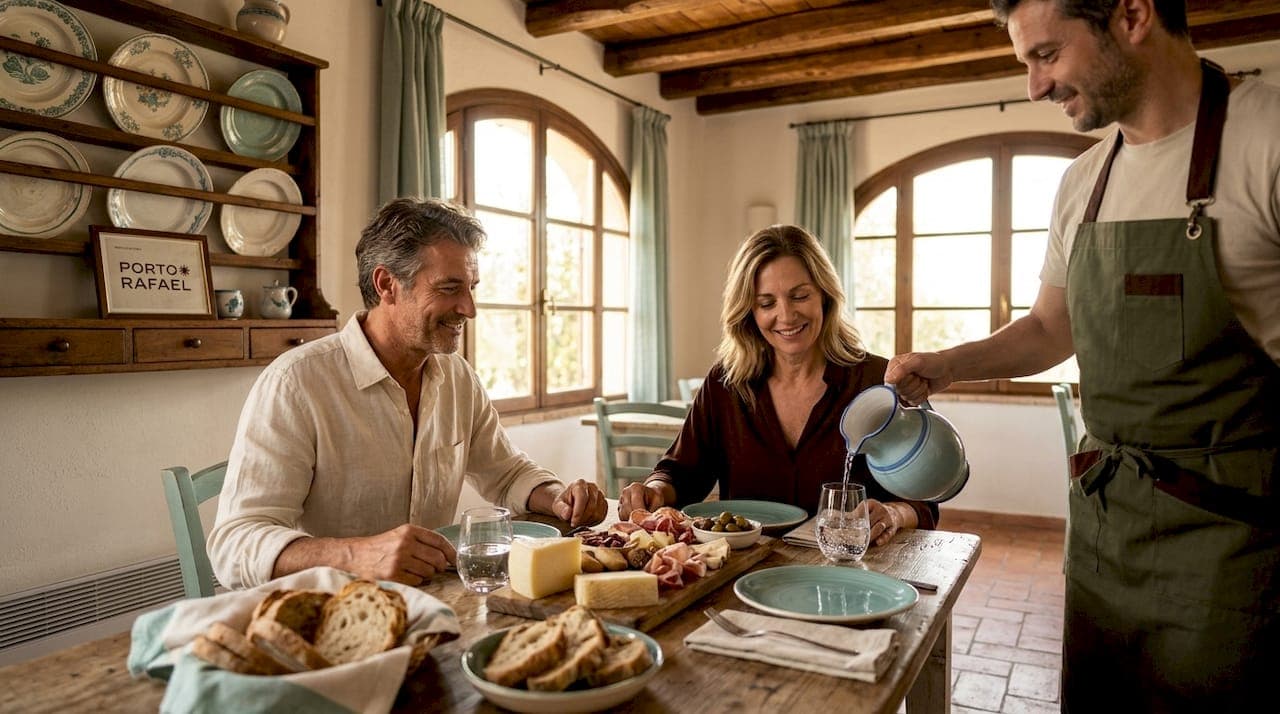
- Agriturismi: Working farms that open their tables to visitors, offering meals drawn almost entirely from their own land. Expect roasted meats, homemade pasta, local cheeses, and house wine poured without ceremony.
- Caseifici: Cheese dairies, some of which welcome visitors to taste and purchase directly. Pecorino sardo, ricotta salata, and fresh gioddu yoghurt are all deeply tied to pastoral Sardinian culture.
- Family-run trattorias: Often unmarked, sometimes requiring a local recommendation to find, but reliably offering dishes that have never appeared on a tourist menu.
- Village sagre: Seasonal food festivals celebrating everything from roasted chestnuts to fresh sausages, where the entire community cooks and shares together.
Lonely Planet's guidance on Sardinia specifically encourages travellers to seek out regional ingredients and places that connect meaningfully to the local territory, rather than defaulting to the easiest option near the beach.
"To truly understand a place, eat where its people eat. In Sardinia, this wisdom leads not to restaurant strips, but to stone courtyards and farmhouse kitchens where the island's soul is quietly, generously served."
Exploring the flavours of Sardinia through genuinely local venues reveals a culinary geography that most visitors never encounter. And the rewards of cultural immersion in Sardinia go well beyond the gastronomic, opening doors to friendships, stories, and an understanding of the island that no guidebook can fully capture.
Pro Tip: When scouting for a genuinely local restaurant, look for visible ties to the territory: a chalkboard listing the farm that supplied today's lamb, a family name above the door that has been there for three generations, or a menu written only in Sardinian dialect. These are the signals that matter.
Authenticity and sensory experiences: What sets local Sardinian restaurants apart
There is a profound difference between a restaurant that serves Sardinian food and one that is Sardinian. The first often curates a greatest-hits menu designed to satisfy expectations. The second cooks what is seasonal, what is local, and what the family knows best, without apology and without adaptation for the broadest possible palate.
Authenticity and sensory experience are directly linked to tourist satisfaction, and these factors also shape how travellers behave after their trip: whether they recommend the destination, whether they return, and how warmly they speak of the experience. The contrast in outcomes between authentic and tourist-oriented dining is significant.
| Experience factor | Tourist-oriented restaurant | Genuinely local restaurant |
|---|---|---|
| Ingredient sourcing | Often imported or generic | Regional, seasonal, often from known local producers |
| Menu language | Translated for broad appeal | Sometimes written only in Italian or Sardinian dialect |
| Preparation methods | Standardised for speed | Traditional, often slow-cooked or hand-prepared |
| Cultural depth | Surface-level Sardinian branding | Rooted in specific local traditions and family heritage |
| Price-to-authenticity ratio | Often higher for less | Frequently excellent value with genuine quality |
| Sensory experience | Predictable | Surprising, memorable, and place-specific |
The sensory dimension of authentic dining is not trivial. The faintly smoky scent of wood-roasted porceddu (suckling pig), the briny sharpness of bottarga shaved over pasta, the unexpected sweetness of seadas drizzled with bitter honey: these are not simply flavours. They are sensory anchors that embed a place permanently into memory. Travellers who experience these dishes in their proper context, at a wooden table under a pergola outside a family home, carry those memories for life.
Understanding Sardinian cuisine traditions is easier when you eat where they are genuinely practised. The warmth of Sardinian hospitality at a family table is itself part of the dish: generous, unhurried, and rooted in the island's ancient culture of welcome.
Pro Tip: To identify authenticity signals in a Sardinian restaurant, check whether the menu changes with the season, whether staff can name the origin of key ingredients, and whether the space feels lived-in rather than staged. These details speak louder than any marketing claim.
Beyond the dining table: Positive impacts on local communities
Every meal you choose at a genuinely local Sardinian restaurant is a small act of economic solidarity, though it rarely feels like one. It feels like a pleasure. But the two are not mutually exclusive. When travellers spend their euros at family-run establishments that source from Sardinian farmers, shepherds, and fishermen, that money circulates through the local economy in a way that spending at chain restaurants or resort buffets simply cannot replicate.
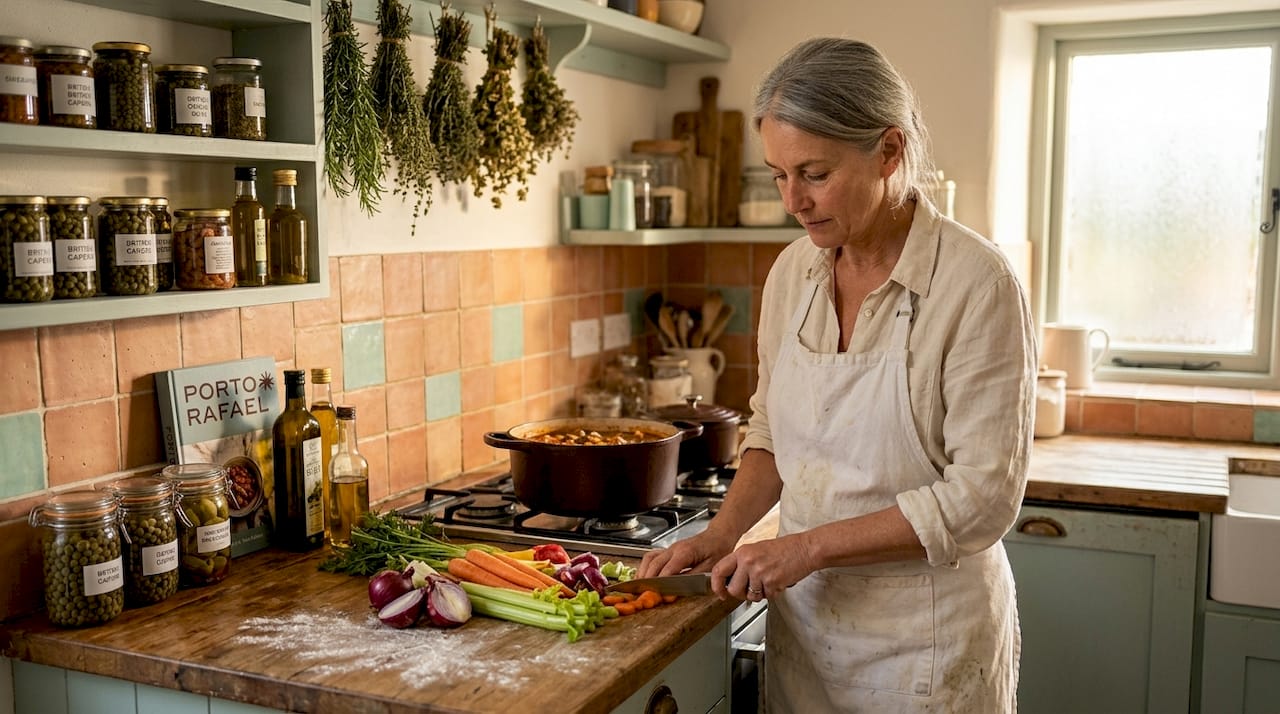
Tourism spending at locally rooted businesses increases the share of visitor money that remains within the destination, supporting local supply chains and the jobs connected to them. This is what economists call the multiplier effect: one euro spent locally generates more economic activity than the same euro spent at a business with external ownership and imported supplies.
Here is how this plays out in practice when you dine at a genuinely local Sardinian trattoria:
- Your payment supports the restaurant family directly, covering wages for local staff and sustaining a business that has often been in the family for decades.
- The restaurant purchases from local producers, meaning part of your bill reaches the shepherd who raised the lamb, the fisherman who landed the mullet, or the farmer who grew the artichokes.
- Local producers invest in their land and livestock, maintaining the agricultural landscapes and traditional practices that make Sardinia visually and culturally distinctive.
- The community retains its character, because local businesses create the texture of authentic village life that attracts discerning travellers in the first place.
"Choosing where to eat is one of the most direct ways a traveller can shape the places they visit. In Sardinia, this choice carries particular weight, because the local food economy is intimately connected to the survival of ancient landscapes and ways of life."
The contrast with tourist-oriented eateries is sharp. Restaurants near major resorts frequently import ingredients, operate with seasonal staff brought from elsewhere, and send profits outside the island entirely. The food may be adequate; the cultural and economic contribution is minimal. By contrast, when you seek out exclusive dining experiences rooted in local tradition, you also invest in the Sardinian village heritage that makes the island so irreplaceable.
How to identify genuinely local and authentic Sardinian restaurants
Knowing why local dining matters is one thing; finding the right places is another. Sardinia's popularity has, inevitably, produced a category of restaurant that borrows the language of authenticity without delivering its substance. Rustic décor, phrases like "traditional family recipes," and photographs of grandmothers in the dining room are staging devices that require scrutiny.
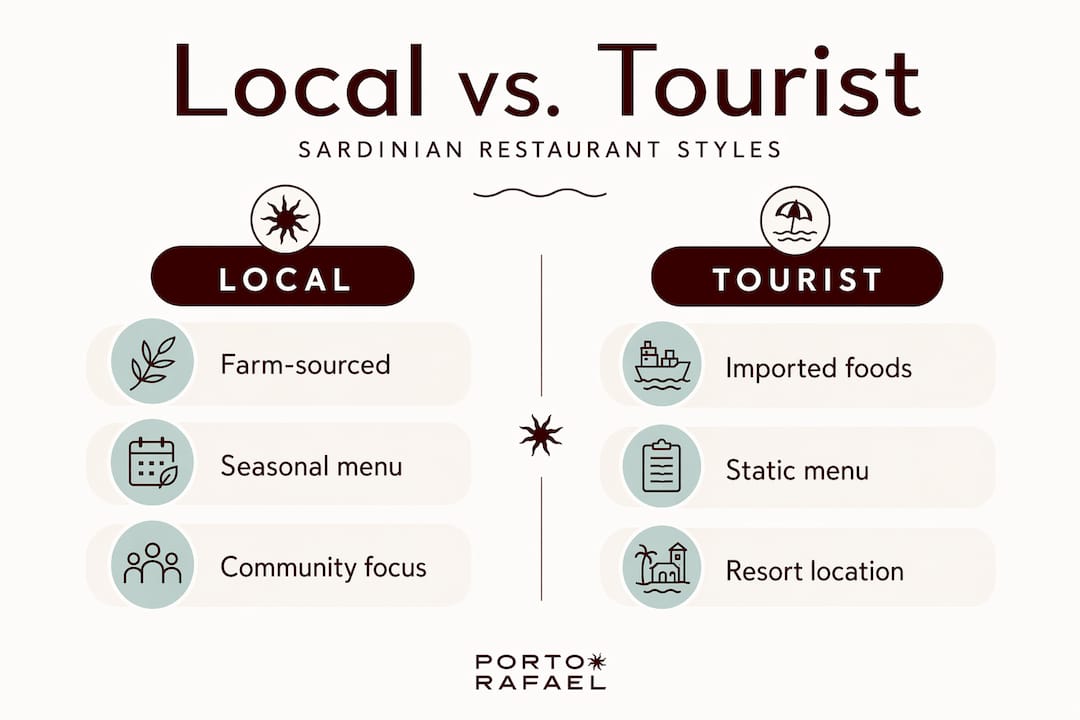
As one considered perspective puts it, "local" is not automatically "authentic": tourist-oriented branding can convincingly mimic local identity, which means the discerning traveller must look beyond the surface to the evidence beneath.
Practical signals that distinguish a genuinely local restaurant from a well-branded imitation:
- The menu changes regularly to reflect what is seasonally available, rather than offering the same dishes year-round.
- Staff speak about ingredients with specificity, naming the farm, the village, or the producer rather than offering vague assurances of freshness.
- The clientele includes Sardinian locals, not exclusively tourists. If the table next to you is occupied by a Sardinian family on a Sunday lunch, that is an excellent sign.
- The location is not solely dictated by footfall, meaning the restaurant is not positioned primarily to capture passing tourist traffic but exists because the community supports it.
- Reservations are sometimes required, because a genuinely popular local restaurant fills up with regulars.
- The wine list is Sardinian, featuring Cannonau, Vermentino, Carignano del Sulcis, and Monica rather than a generic international selection.
Local dining for deeper immersion involves spending time in inland or community contexts, not just the coastal areas most tourists see. Villages in the Barbagia, the Ogliastra, and the Gallura hinterland offer dining experiences of extraordinary depth and negligible visibility in mainstream travel content.
The wisest approach to booking authentic Sardinian meals often begins with a conversation: ask at your accommodation, speak to the person behind the counter at the local alimentari, or simply follow a Sardinian resident from the market to their favourite lunch spot.
Pro Tip: Do not be deterred by a lack of English on the menu. An Italian or Sardinian-only menu is frequently the most reliable indicator that a restaurant is not catering primarily to international tourists. A smartphone and a spirit of curiosity will carry you through the ordering process admirably.
A fresh look: What most travellers get wrong about dining locally in Sardinia
There is a comfortable assumption in much travel writing: that choosing "local" dining is inherently virtuous and straightforwardly rewarding. The reality is more interesting, and more nuanced. Surface-level local branding, as we have already noted, can be entirely hollow. But there is also a subtler mistake that even well-intentioned travellers make: confusing the gastronomic experience with the full value of truly local dining.
The deepest rewards come when local food is positioned as cultural learning rather than mere consumption. Travellers who approach a Sardinian meal with genuine curiosity, who ask where the bottarga came from, who linger over the cheese course to understand how each variety differs by region, who accept the house digestivo with the spirit in which it is offered, these travellers form attachments that sustain a desire to return. The meal becomes a doorway, not a destination.
There is also a hard truth about economic impact: multiplier effects depend entirely on local supply chains actually being present. A restaurant that claims local identity but sources its ingredients from distant suppliers generates little of the community benefit that genuine local dining creates. This is why knowing what to look for is not simply a matter of personal preference; it shapes real outcomes for real people and places.
The emotional dimension of genuinely local dining in Sardinia is something most travel guides undervalue. A meal shared with a Sardinian family, however briefly, plants a memory of specific warmth and generosity that no amount of beautiful landscape photography can replicate. Returning visitors often cite these human encounters, not the sunsets or the sea, as the reason they came back.
For those who wish to explore a quieter, more reflective side of Sardinia, considering off-season Sardinia is particularly rewarding. Local restaurants operate with unhurried grace when the summer crowds have gone, and the welcome at the table is even warmer.
Elevate your Sardinian dining adventures with us
Porto Rafael, the rare gem of Gallura's northern coast, understands that the finest Sardinian experiences are always rooted in place. At Porto Rafael's gastronomy, every culinary offering is shaped by a deep respect for the island's traditions, its seasonal rhythms, and the extraordinary produce of this captivating corner of Sardinia.
At Solaz Restaurant, the kitchen celebrates the genuine flavours of Sardinia with ingredients sourced from local producers and recipes that honour the region's culinary heritage. Whether you are seeking a languid long lunch or an elegant dinner as the sun descends over the Tyrrhenian, Porto Rafael offers dining experiences that feel truly, beautifully of this place. Reserve your table and allow the island's finest flavours to find you.
Frequently asked questions
What makes Sardinian local restaurants unique from tourist eateries?
Genuine Sardinian local restaurants use traditional recipes, source ingredients regionally, and are often community- or family-run, offering a more immersive and authentic cultural experience, as highlighted by Sardinia travel guidance emphasising regional food and territorial connection.
How can I tell if a Sardinian restaurant is truly local?
Look for venues with locally sourced menus, native language signage, visible community connections, and recommendations from Sardinians, because as research shows, "local" branding alone does not guarantee authenticity.
Does dining at local Sardinian restaurants benefit the local economy?
Yes, your spending supports local farmers and businesses, with a multiplier effect that circulates money through Sardinian supply chains and benefits the broader community far more effectively than spending at tourist-focused establishments.
What is the best way to experience authentic Sardinian cuisine?
Seek out inland or community-focused restaurants, agriturismi, and family-run venues recommended by locals, as place-based dining in non-tourist contexts offers the most genuine and memorable connection to Sardinian food culture.